
- Home
- Know How
- Emission Measuring Instrument
- Select & compare emission measuring instruments – decision guide | Testo
Select & compare
emission measuring instruments

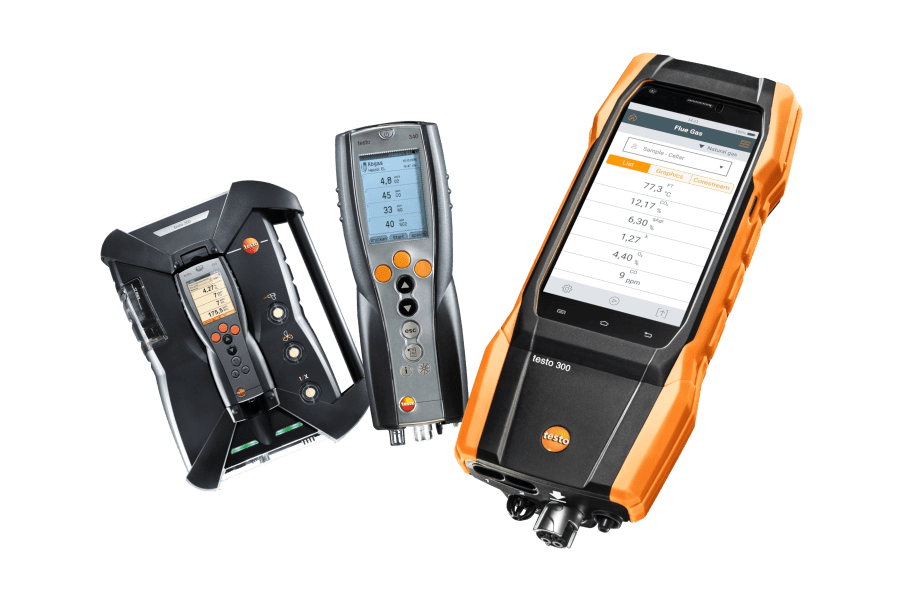
Choosing the right emission measuring instrument starts with a clear definition of the measurement task: is it recurring service measurements on multiple systems or continuous emission monitoring of a large combustion plant? Only when the task, components, measuring ranges and documentation requirements are known can you decide whether a mobile or stationary system is the better choice.
Key questions for instrument selection
Before comparing specific instrument models, users should answer a few basic questions:
Which gas components should be measured (e.g. O2, CO, CO2, NOx, SO2, dust)?
Is it a one-time, recurring or continuous measurement?
How many measuring points must be monitored and how accessible are they?
Which measuring ranges and accuracies are required?
Which legal requirements and reporting obligations apply?
Checklist for users
A simple checklist helps with preparation:
Note down the system type and fuel(s),
Compile relevant limit values and standards,
Define planned measurement intervals and duration of use,
Clarify requirements for reports and documentation,
Consider budget and service requirements.
Based on this, you can narrow down whether a portable multi-gas emission measuring instrument or a stationary emission measurement system is needed and which instrument categories should be considered.
Comparison of mobile vs. stationary emission measurement systems
Mobile emission measuring instruments
are designed for flexible use at changing measuring points,
combine multiple sensors (e.g. electrochemical and NDIR) in a portable housing,
are ideal for service, commissioning, campaign measurements and recurring checks,
offer integrated logging functions for test reports.

Key selection criteria at a glance
Key selection criteria include:
Measurement task: service, commissioning, campaign measurements or continuous monitoring,
Components and measuring ranges: which gases, at which concentrations,
Ambient conditions: temperature, dust, humidity, accessibility of the measuring point,
Data handling: need for automatic averaging, long-term archiving, interfaces,
Service & maintenance: sensor service life, calibration intervals, availability of support.
For users, it is helpful to compare these criteria in an evaluation matrix and assess potential instrument concepts – for example, different mobile instruments or combinations of a stationary system plus a mobile reference instrument – based on their own requirements.
Examples of typical application scenarios

Service use on heating and boiler systems
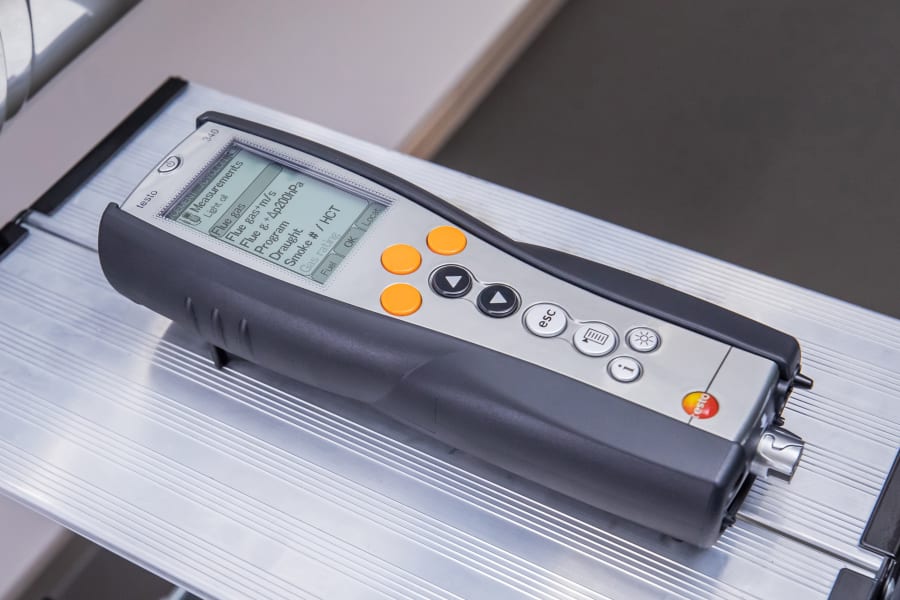
Service technicians who regularly maintain heating or boiler systems benefit from a compact, mobile emission measuring instrument that records several gas components simultaneously and automatically creates test reports. Fast readiness for use, robust sensor technology and easy operation are important here.
Learn more

Emission measurement on combined heat and power plants
For CHP operators who need to check emission limit values on a recurring basis, a combination of a mobile emission measuring instrument for campaign measurements and permanently installed measurement technology at central points can make sense. This allows both legal checks and operational optimisations to be covered efficiently.
Learn more

Monitoring a large combustion plant
In large combustion plants, waste incineration plants or energy-intensive industrial processes, a stationary emission measurement system is usually required to continuously monitor emissions and document measurement results in half-hour and daily averages. Mobile emission measuring instruments complement these systems for plausibility checks and additional measurements on auxiliary systems.
Learn more
Do you have questions or would you like personal advice? Contact us!
We look forward to supporting you with our expertise and individual solutions.