
- Home
- Know How
- Emission Measuring Instrument
- Emission measuring instruments – measuring principles & technologies | Testo
Technologies in emission measuring instruments –
Measuring principles & system design

Emission measuring instruments combine physical measuring principles such as NDIR and electrochemical sensor technology with a sampling and gas conditioning system tailored to the application, in order to reliably determine gas components such as CO, CO2, NOx or SO2 in mg/m3 or vol.%. The choice of the right technology determines whether measured values are stable, compliant with standards and capable of long-term operation under real operating conditions.
NDIR measurement – infrared technology for gas analysis
Non-dispersive infrared measurement (NDIR) is one of the most important technologies in emission measurement technology. It is based on the fact that certain gases – such as CO, CO2 or NO – absorb infrared radiation in characteristic wavelength ranges. An NDIR analyser sends infrared light through a measuring cell filled with the gas to be analysed and measures the attenuation of the light. The gas concentration is calculated from this attenuation using the Beer-Lambert law.
NDIR measuring paths are characterised by high long-term stability and selectivity for specific components. They are frequently used for continuous emission measurements where measuring ranges spanning several orders of magnitude (e.g. from a few mg/m³ to the g/m³ range) must be covered. In many CEMS systems, several NDIR channels are used in parallel to detect different components simultaneously.
Advantages and limitations of NDIR technology
The advantages of NDIR measurements include:
high long-term stability and low drift,
good selectivity for specific gases,
suitability for continuous measurements with short update times.
Limitations arise where gases have no pronounced IR absorption or where cross-sensitivities between similar absorption bands must be carefully compensated. In addition, NDIR measurements require a stable temperature and a defined pressure in the measuring system so that the conversion to mg/m3 under standard conditions is carried out correctly.

Electrochemical and paramagnetic sensors
Electrochemical sensors are frequently used for measuring O2, NO, NO2, SO2 or CO in emission measuring instruments. An electrochemical sensor consists of a measuring cell with electrolyte and electrodes. The gas to be measured diffuses into the cell, reacts electrochemically and generates a current proportional to the gas concentration. Electrochemical sensors are compact, comparatively cost-effective and particularly suitable for mobile emission measuring instruments.
Paramagnetic sensors are used in particular for precise O2 measurements. They exploit the fact that oxygen is paramagnetic, i.e. attracted by a magnetic field, while most other gases are diamagnetic. In a paramagnetic O2 sensor, a change in the O2 concentration in the measuring gas leads to a measurable movement or change in force in a magnetic field. This change is detected electrically and converted into an O2 concentration.
For users, questions arise such as: when is an electrochemical sensor sufficient, and when is a paramagnetic sensor advisable? The answer depends on the requirements for accuracy, long-term stability and maintenance effort. In mobile instruments, electrochemical sensors offer a good compromise between precision and ease of use. In stationary systems with high demands on accuracy and availability, paramagnetic O2 sensors can offer advantages.

Sampling, heated lines and gas conditioning
For sensors or measuring paths to deliver reliable results, the flue gas must be correctly extracted and conditioned before the actual analysis. A typical emission measurement chain therefore includes:
a heated extraction probe in the flue gas stream,
a heated sample line,
filters and particle separators,
gas conditioning modules (e.g. coolers, condensate traps),
flow monitoring and, if necessary, pumps.
The heated extraction probe ensures that condensable components do not already settle in the probe and falsify measured values. Heated sample lines prevent condensation up to the gas conditioning stage. In the gas conditioning stage, the flue gas is brought to defined conditions – for example by drying to a specific residual moisture level or by separating dust and aerosols. Only then does the conditioned gas reach the analysers.
Typical components of a gas conditioning system
A standard gas conditioning system for continuous emission measurements often includes:
pre-filters for separating coarse particles,
gas scrubbers or drying units to reduce humidity,
fine filters for removing residual particles,
monitoring devices for flow and condensate.
The design of the gas conditioning system depends heavily on the application. In dust-intensive processes (e.g. cement kilns), filters and probes must be particularly robust and easy to maintain. In moist, sulphur-containing flue gases, an appropriate choice of materials is crucial to avoid corrosion and measurement errors.
System selection: mobile vs. stationary emission measuring systems
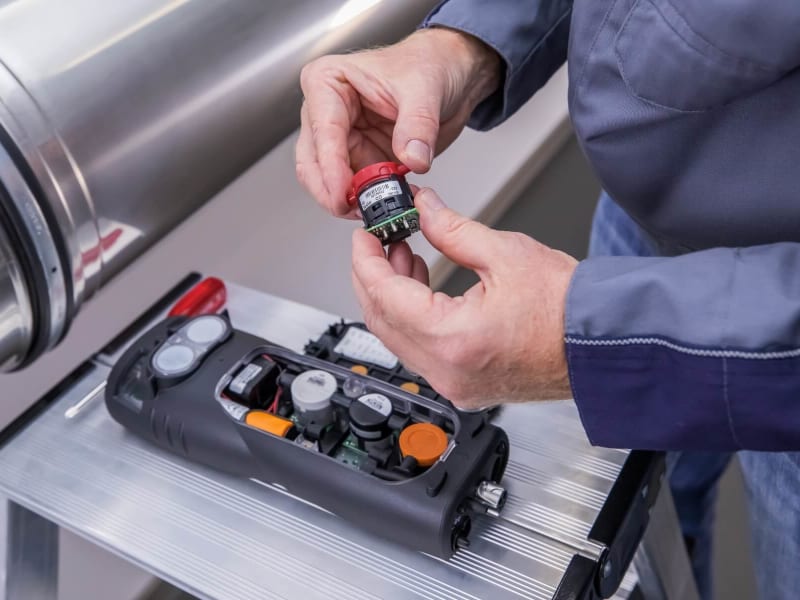
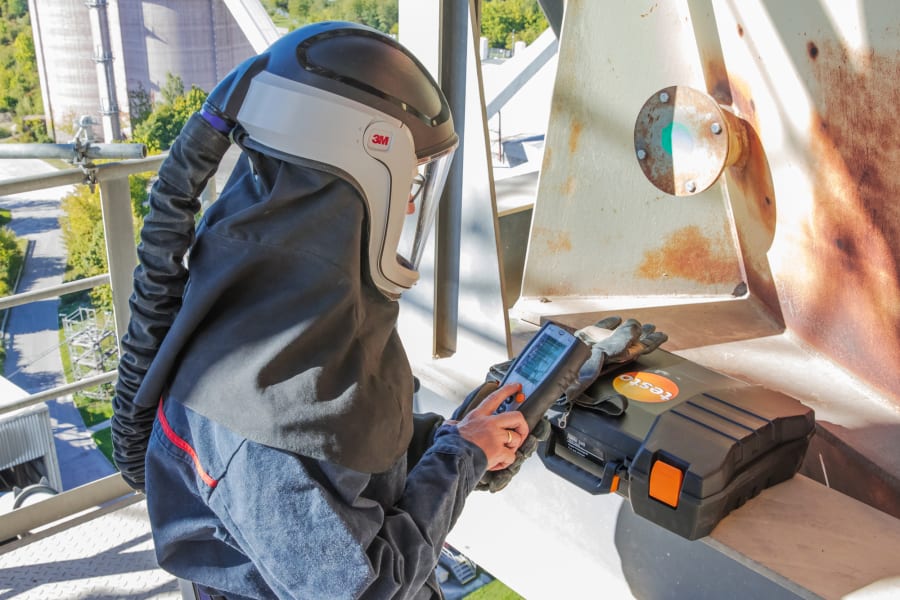
From a technological perspective, mobile and stationary emission measuring systems differ primarily in the design of sampling, gas conditioning and analyser technology. Mobile instruments frequently combine electrochemical sensors and compact NDIR measuring paths in a portable housing optimised for use at changing measuring locations. Stationary systems, on the other hand, are designed for continuous operation at a fixed measuring location and feature extended gas conditioning, automatic zero and span checks, and continuous monitoring devices.
The decision between mobile and stationary technology depends on questions such as these:
Is it a matter of recurring checks or legally required continuous monitoring?
How many measuring locations need to be monitored, and how accessible are they?
What accuracy and availability requirements apply?
Mobile emission measuring instruments are ideally suited for service technicians, commissioning or campaign measurements at multiple plants. Stationary systems are the first choice when limit values must be permanently monitored and corresponding requirements are in place.
Do you have questions or would you like personal advice? Contact us!
We look forward to supporting you with our expertise and individual solutions.