
- Home
- Know How
- Pressure Measurement
- Pressure measurement: Applications in heating, air conditioning & refrigeration | Testo
Pressure measurement in heating, air conditioning, refrigeration and cleanrooms
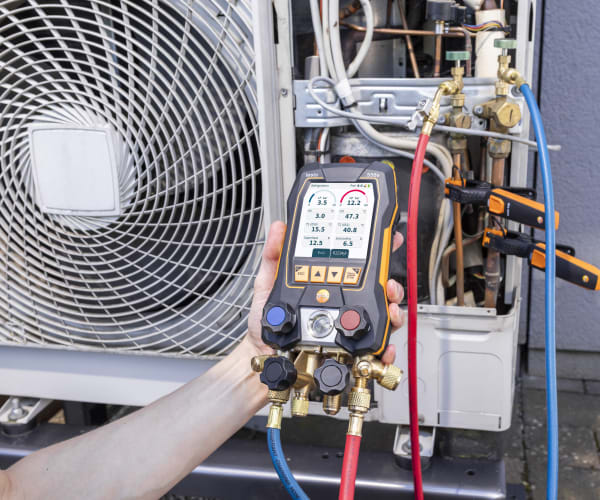
First define the system, medium, operating condition and measuring objective. Then select the type of pressure, measuring range, connections and scope of documentation to match the application.
Pressure measurement on heating, air conditioning, and ventilation systems
For gas appliances, a distinction is made between dynamic gas pressure and static gas pressure. Depending on the measuring task, static pressure or differential pressure is also recorded on heating systems. In air conditioning and ventilation systems, for example, the differential pressure before and after a filter is measured. For the evaluation, the measuring point, connection direction, operating condition, volume flow, and system or filter documentation are important.
Gas pressure and gas pipe testing
Dynamic gas pressure is measured while gas is being drawn off – usually with a connected appliance in a defined operating condition. Static gas pressure is measured when no gas is being drawn off.
Test pressure, test duration and the procedure for a gas pipe test depend on the system and the applicable technical requirements. Load, tightness and serviceability tests are not assessed on the basis of a single blanket value. They must be carried out according to the relevant procedures and by qualified specialist personnel. For repeatable results, the operating condition, connected appliances, measuring point and time, among other things, are documented.
Filter measurement
A rising differential pressure between filter inlet and filter outlet can indicate higher flow resistance and increasing filter contamination at a comparable volume flow. As the differential pressure also changes with the volume flow, this should be taken into account or documented during evaluation.
The maintenance or replacement limit is taken from the filter or system documentation. It cannot be derived generally from a single measured value.

Measurement procedure and plausibility check
Before measuring, check the device, unit, pressure type, zero point, connection direction, hose system, and measuring range. Also record the operating condition and, where relevant, the volume flow. A conspicuous differential pressure can, for example, result from a changed volume flow, a different damper position, or a leaking or kinked hose system.
Pressure measurement on refrigeration systems and heat pumps
For refrigeration systems and heat pumps, pressure, temperature and process data are assessed together. Pressure measurement in the refrigeration circuit, a pressure hold test, leak detection, refrigerant charging and evacuation are different tasks, each with its own measuring objectives and instrument requirements.

Pressure measurement in the refrigeration circuit
During operation, the pressure values in the refrigeration circuit are assessed together with temperature and process data. Depending on the system and measuring method, values are recorded on the high and low pressure sides. Their significance depends, among other things, on the refrigerant, operating mode, ambient conditions and system condition.
A single pressure value is therefore usually not sufficient for a complete assessment. Compare it with the specifications or reference values for the specific system and take appropriate temperature measurements into account. The measuring instrument must match the pressure level, refrigerant, connection and measuring range. Document the measuring point, refrigerant, operating mode, pressure values and relevant operating conditions.

Pressure testing and leak detection
In a pressure test, the system is subjected to a defined test pressure according to a specified procedure. If it is observed whether the pressure is held over a certain period, this pressure hold procedure is used to assess tightness. Test pressure, test medium, test duration and assessment depend on the system, the manufacturer's specifications and the applicable technical requirements. Pressure changes must be assessed in relation to temperature trend, measuring conditions and measurement uncertainty.
Leak detection has a different objective: it is used to locate a suspected leak point. For this, a leak detector suitable for the refrigerant and procedure, or another designated method, is used. A pressure drop may indicate a leak but does not show where the leak point is located. The test method, result and any measures taken should be documented.

Evacuation and vacuum measurement
During evacuation, air and moisture are removed from the refrigeration circuit. The target value and procedure depend on the system and manufacturer's specifications. A suitable vacuum measuring instrument monitors the low pressure range; an ordinary pressure gauge is usually not sufficient for this.
Once the target value has been reached, the system is disconnected from the vacuum pump – if the designated procedure requires it – and the pressure trend is observed over the specified test period. A pressure rise can have various causes and is not automatically proof of a leak. The observation does not locate a leak point and does not replace any pressure or tightness test that may be prescribed. Document the target value, start and end value, and the observation duration.
Pressure measurement in cleanrooms
In cleanrooms, differential pressure is used to monitor the intended pressure cascade between zones. The permissible values result from the cleanroom concept, the process requirements and the applicable quality specifications.
Pressure cascade and measurement direction
Measurement direction, reference room and measuring point must be clearly defined. A reading without specifying both connected rooms is incomplete. The test report records at least both zones, measurement direction, unit, time and operating condition.
Single measurement or continuous monitoring?
A single measurement provides a snapshot. Continuous monitoring can additionally reveal fluctuations, door openings and temporary deviations. Which solution is appropriate depends on criticality, process requirements and the necessary response time.
Practical requirements
For low differential pressures, measuring range and resolution are especially important. Also check hose routing, connection orientation, zero point and the position of the measuring points, so that the measurement setup does not distort the pressure cascade.

Do you have questions or would you like personal advice? Contact us!
We look forward to supporting you with our expertise and individual solutions.