
- Home
- Know How
- Thermal Imaging Camera
- Resolution, NETD, FOV & focus: assessing image quality correctly | Testo
Resolution, NETD, field of view and focus:
How to assess thermal imaging quality

Thermal image quality is not a single value, but the interaction of resolution, optics/field of view and therefore IFOV, NETD for contrast, and focus for sharp measurement points. By systematically checking these four factors, you can compare models realistically and avoid measuring small targets as “too small” or making slight temperature differences “invisible”.
Which specifications matter – and what for?
Resolution determines how many measurement points lie on the target; FOV/lens determines how large the target appears in the image (and therefore IFOV at your working distance); NETD determines whether small temperature differences become visible as a pattern; focus determines whether temperature information is clearly separated. In practice, IFOV is often the strictest gate: if the target is not imaged large enough, better NETD values or additional features help little.

Detector resolution: how many measurement points you have
Detector resolution is often specified as a pixel count. It describes how many temperature values are captured per image.
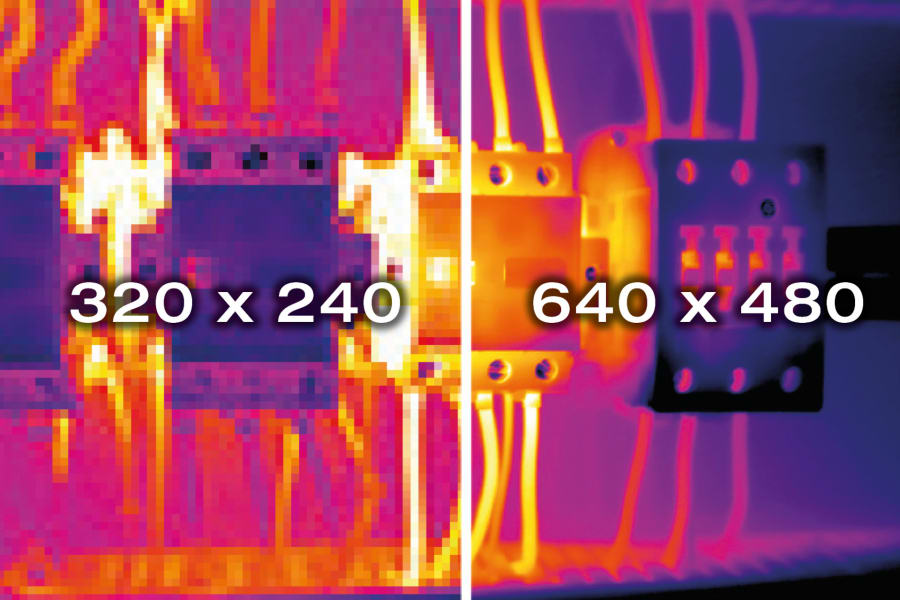
More resolution always helps when your targets are small (e.g. terminals, connectors, small PV connections) or when safety or access reasons prevent you from moving closer. More pixels then fall on the target – reducing mixed-pixel effects.
High resolution does not replace suitable optics or a suitable distance: if you are too far away or use a very wide field of view, the target remains small. In addition, blur can reduce effective detail detection.
SuperResolution: more measurement points without a larger detector
High resolution does not replace suitable optics or a suitable distance: if you are too far away or use a very wide field of view, the target remains small. In addition, blur can reduce effective detail detection.
Field of view (FOV) & lens selection: what happens in the image section
The field of view determines how much of the scene you see at once. It is therefore a direct lever for deciding whether to scan large areas efficiently or zoom in on small targets.
Wide angle: overview and confined spaces
Wide angle is useful for building overviews or confined technical rooms. The trade-off is that small targets appear small.
Telephoto: small targets from a distance
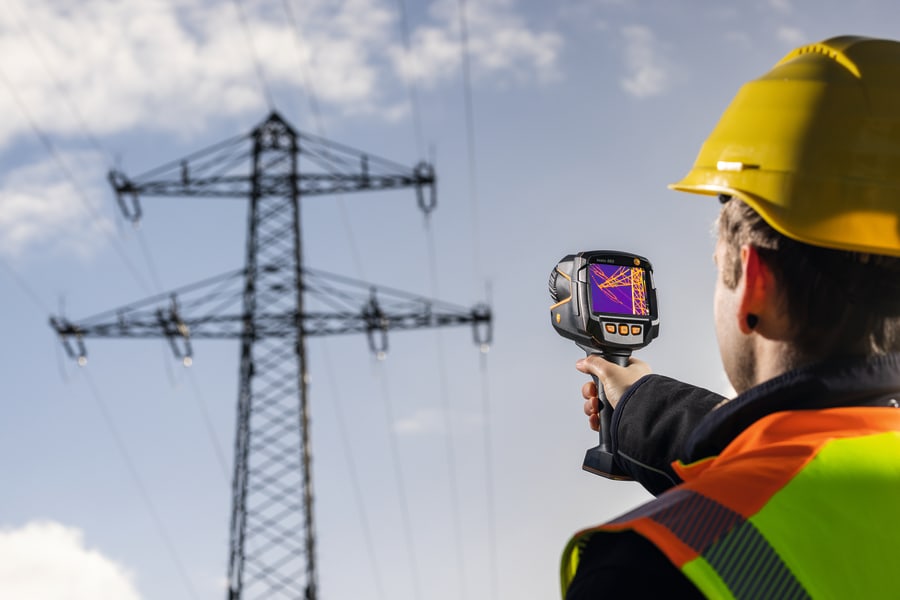
Telephoto lenses help image small targets larger from a greater distance. This is particularly relevant in electrical thermography or PV when safety distances or accessibility determine the distance.
IFOV as a practical gate: object size, distance, measurability
IFOV describes geometric resolution: how large is the area a pixel “sees”? If this area is larger than your target, the pixel measures object + background.
Understanding mixed pixels
A mixed pixel produces mixed temperatures: the image may indicate a hotspot, but the numerical value is not “object-pure”. This is one of the main reasons why absolute temperatures for small targets quickly become misleading.
Procedure: define the target → check the distance → derive the optics/resolution
Define the target size.
Define the typical working distance.
Check whether the target is sufficiently large in the image (IFOV).
If not: reduce the distance or adjust the optics/resolution.
Two terms are important in practice: IFOVgeo (smallest detectable object per pixel) and IFOVmeas (smallest object whose temperature can be measured reliably). Rule of thumb: IFOVmeas ≈ 3 × IFOVgeo. For an exact measurement, the object should be approximately 2–3× larger than the smallest detectable object.
With a spatial resolution of 3,5 mrad and a measuring distance of 1 m, one pixel corresponds to an edge length of approximately 3,5 mm. For reliable temperature values, the measuring object should therefore be significantly larger than 3,5 mm (in practice: at least approx. 2–3 pixels edge length).
Thermal sensitivity (NETD): contrast and “noise”
NETD describes how finely temperature differences can become visible as contrast.
Low contrast (buildings/surfaces) vs. hotspot scenes (electrical)
In building applications, patterns often have low contrast – NETD can therefore be decisive. In electrical applications, hotspots are often more contrasted; there, IFOV, focus and parameterization (ε/RTC) are often the dominant sources of error.

Focus: sharpness is measurement quality
Focus determines whether temperature information is spatially separated cleanly.
Blur smears edges and hotspots. As a result, measurement points can fluctuate more, especially with small targets or measurement points at boundary areas.
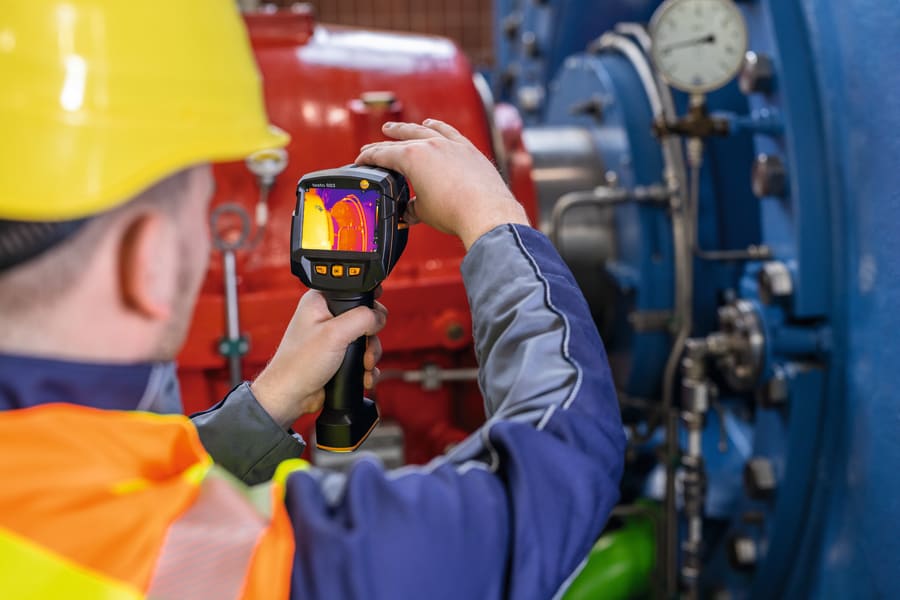
Manual focus is advantageous when you want to focus specifically on small targets at a defined distance. Automatic methods can be convenient, but depend on scene contrast and reflections.
Terminal: the gate is IFOV/focus – it must be large enough and sharply imaged; otherwise the numerical value is a mixed value. Building façade: the gate is often NETD/environment – small patterns must be visible in contrast and boundary conditions must be suitable.

Next steps: software and instrument selection
Check whether the software/app supports your documentation workflow, and then select the right measuring instrument for your application.
Do you have questions or would you like personal advice? Contact us!
We look forward to supporting you with our expertise and individual solutions.