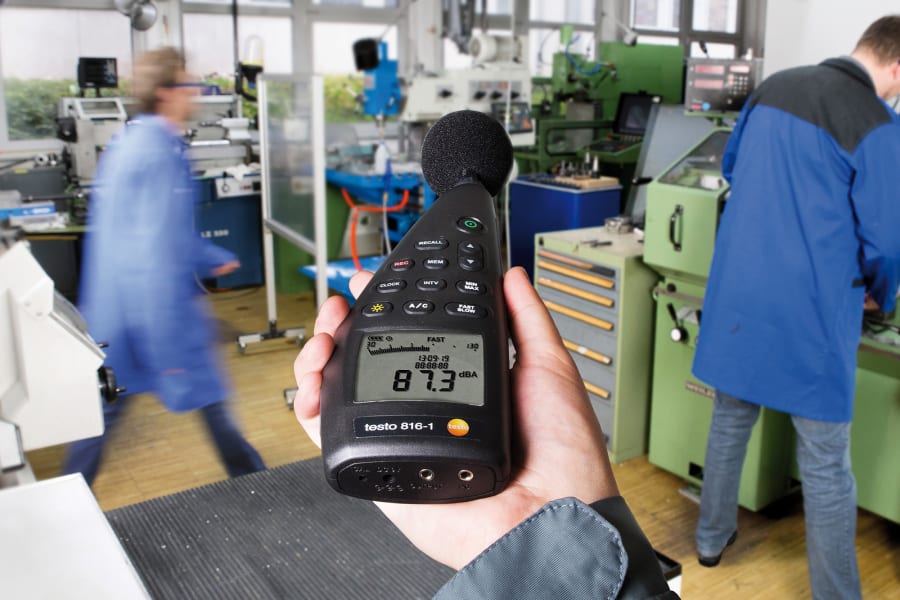
Sound level meter
Accurately measured decibels
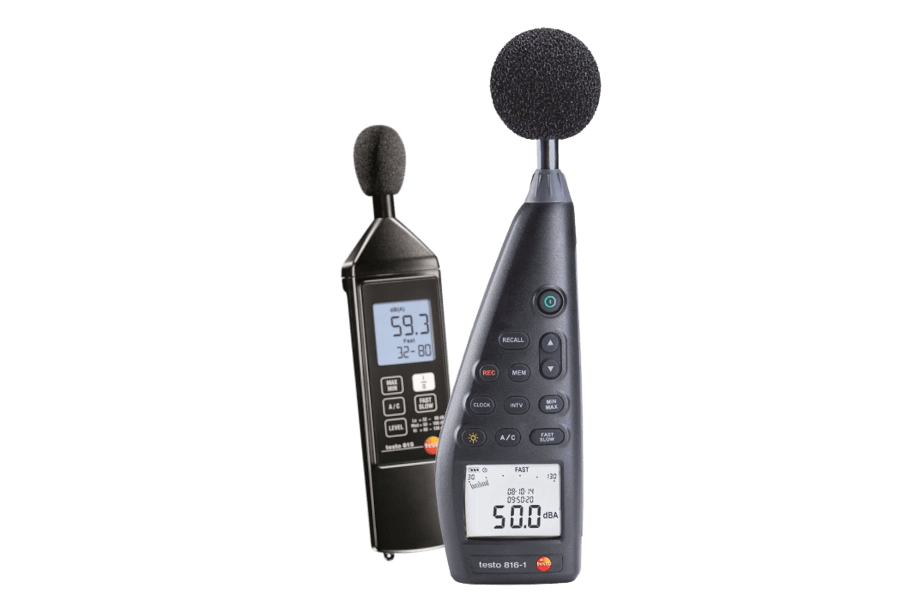
Sound level meters are used to measure volume in decibels, both in the workplace and at home. Similar to temperature, noise is often perceived subjectively. For example, a person who feels disturbed by a neighbor’s loud music may perceive it as noise, but objective measurement in decibels often shows that the sound does not actually qualify as excessive noise.
In the workplace, sound level meters are essential for assessing whether employees require hearing protection or whether the existing sound levels remain reasonable and non-hazardous to health.
Typical areas of application for sound level meters include:
In homes, to determine the surrounding noise levels
In building services
In air conditioning and ventilation systems
At workplaces, in offices, and on machinery
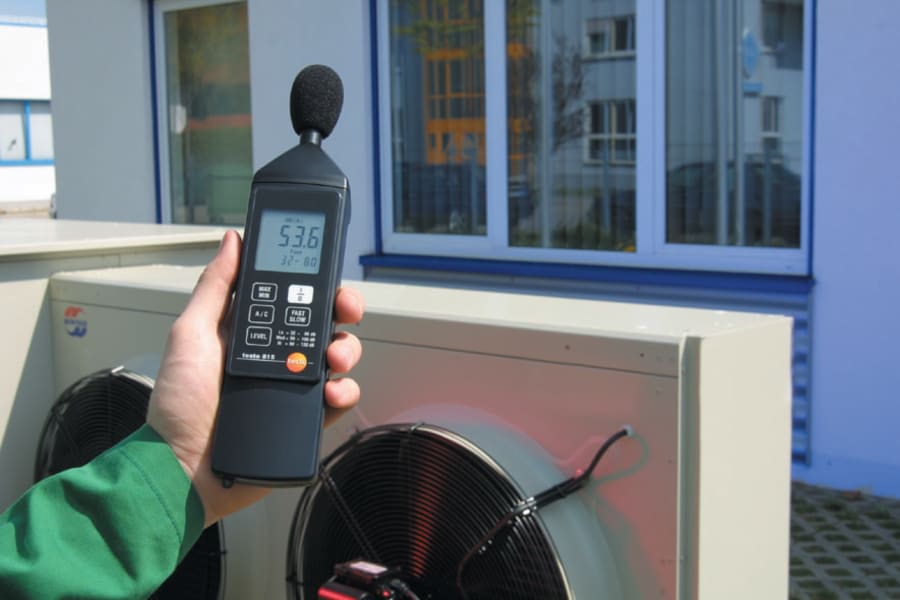
Sound level meters: Standard-compliant measurements for industry and trade
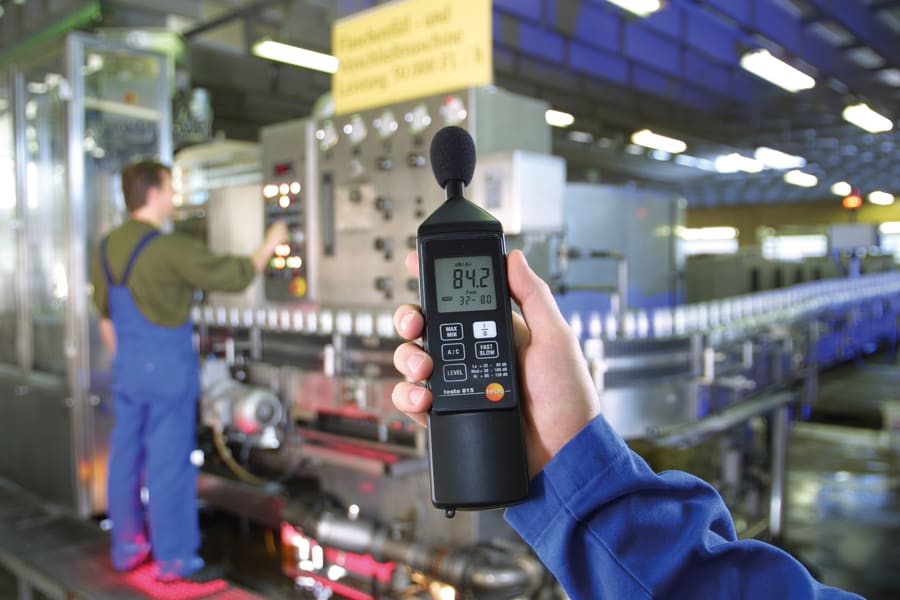
The sound level meter is suitable for standard-compliant sound measurements and displays the measured values in decibels. A sound level meter is indispensable for employers in particular, as they must ensure that the working and immission protection conditions at the workplace are complied with. This takes account of occupational health and safety, which focuses on keeping employees healthy. Equally important is the measurement of decibels in combustion, heating and air conditioning systems, for which the testo 815 sound level meter is available, for example. The testo 816 sound level meter is also suitable for this purpose and is available as a non-compliant sound measuring instrument. It is always important to comply with the legal standards, which is only possible when using the tested sound level meters. Testo's sound level meters are based on the standard IEC 61672-1, which has been in force for several years. In contrast to the previous standard, it is geared towards higher accuracy. There are three accuracy classes, with testo sound level meters corresponding to class 2.
Loudness measurement in heating technology, in particular burners
Measurement of the loudness of machines and systems in production
Measurements in the area of workplace regulations (e.g. noise levels in offices) Determination of decibels at public events Testing of units and compressors (e.g. in refrigeration systems) including noise levels in offices)
Determination of decibels at public events
Testing of units and compressors (e.g. refrigeration systems)
Sound meter: Important settings
The sound level meter measures the volume in decibels and thus provides the person taking the measurement with an objective value. However, it is important to make a few settings on the sound level meter in order to actually obtain usable results. For example, the time weighting must be set, which allows the device to react to sounds that change slowly or suddenly in volume. The frequency weighting must also be selected in order to determine the sound level in a linear or aurally accurate manner. The A characteristic curve, which is standardized, is used for aurally accurate assessment of the volume. It is precisely implemented by the testo sound level meters. Furthermore, it is of course important that the instrument's microphone is aligned with the noise source. Only if these settings are actually made can the noise meter capture the sound waves correctly and display the measurement result correctly in decibels.
It is not only the settings with which the sound level meter starts the measurements that are important, but also the external conditions. The sound level meter makes no distinction between the different noise sources. So if the volume in decibels is to be measured at a machine and the employees there are talking very loudly, this factor plays a role. The total volume is measured, which is also the correct value. For the protection of the employees working on this system, the noise of the machine alone is irrelevant. What matters is the overall noise level to which the employees are exposed on a daily basis.
DB measuring device: Observe limit values
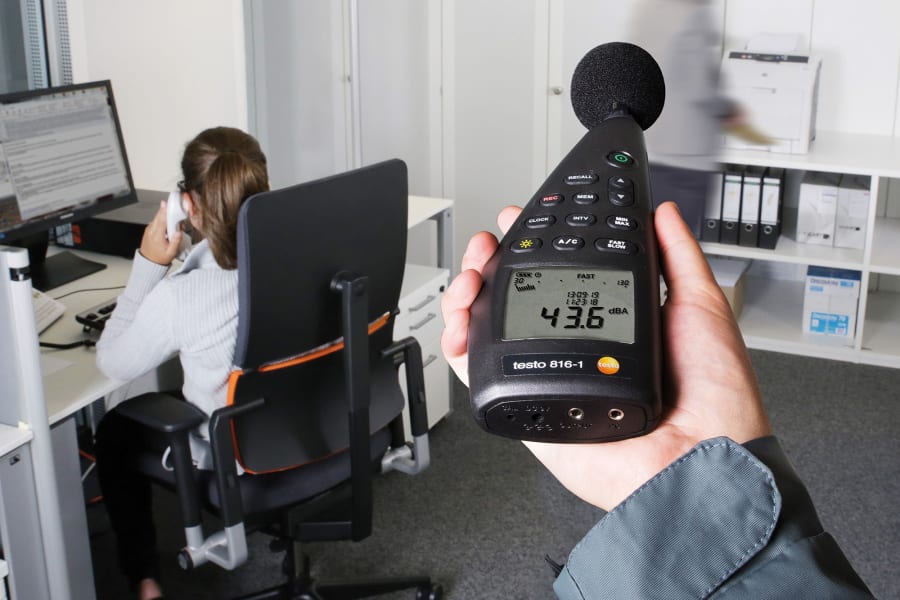
When evaluating the measurement results in decibels, it is important to know what the law says and this sets certain limits for the volume. The reason: noise causes illnesses, the first of which is hearing loss. Once destroyed, hearing does not recover! Hearing loss is therefore at the top of the list of occupational diseases, as no subsequent improvements will help. It is therefore important to adhere to the specified values from the outset. The sound level meter is intended to help prevent damage to health and indicates when there are health concerns. Currently, 55 to 85 decibels are considered harmless to health, whereby the level of the guideline values depends on the type of workplace. In a production hall, 70 decibels is still considered the minimum value, but the same value would be far too loud for an open-plan office. There should be no more than 55 decibels, which is roughly equivalent to a conversation at a normal volume. However, to determine the exact value, a suitable sound level meter must be used.
If existing noise is to be assessed objectively, it must actually be measured at the point of greatest influence. If nobody has to work on the machine, its noise level does not need to be monitored, at least for health and safety reasons. It is therefore more important to measure where people are actually affected and impaired.