Directly from the manufacturer
Free delivery Australia wide
Fast delivery
Secure payment
Directly from the manufacturer

- Home
- Know How
- Emission Measuring Instrument
- Sampling & gas conditioning in emission measuring instruments
Sampling & gas conditioning for reliable emission measurements

Sampling and gas conditioning ensure that the flue gas arrives in an emission measuring instrument under defined conditions – without condensation, without excessive dust load and with stable temperature. They are therefore just as important for measurement quality as the actual sensors or NDIR measuring paths.
Why sampling and gas conditioning are so important
Even the best measurement principle delivers incorrect results if the measurement gas is not sampled and conditioned correctly. Deposits in lines, condensation of water vapour or chemical reactions in the sampling system can distort readings or damage sensors. A suitable sampling and gas conditioning path ensures that the gas reaching the analyser is representative of the flue gas flow and stable in its properties.
In emission measurement technology, hot, dusty and moisture-laden flue gases are often encountered. Without heated probes and lines, condensate would form in which water-soluble components accumulate or precipitate. This changes the gas composition and leads to systematic measurement errors. At the same time, dust and particles must be reduced so that measurement cells, valves and sensors do not become blocked.
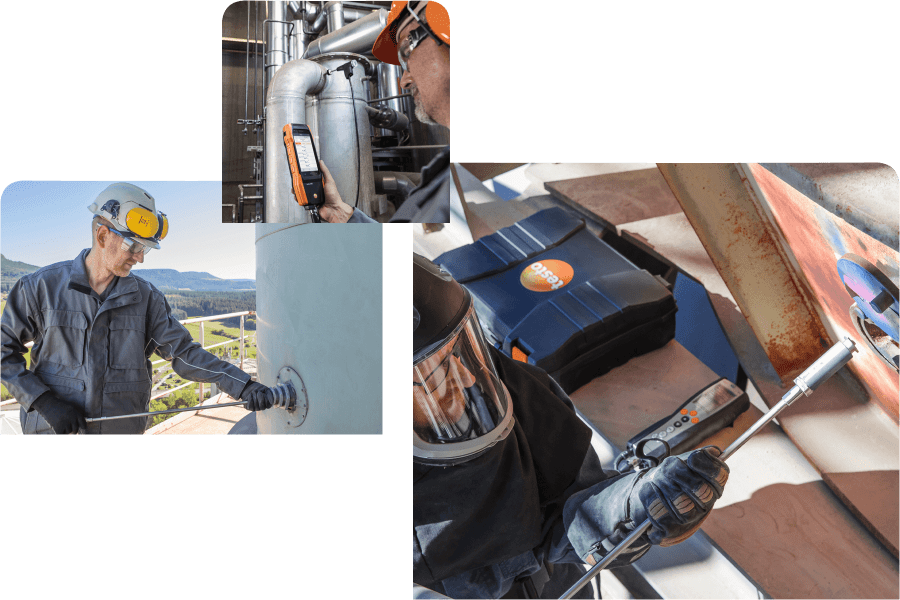
Structure of a typical emission measurement path
From the probe to the analyser
A typical emission measurement path includes several steps:
Sampling in the flue gas flow via a heated probe at a defined measurement point,
Transporting the gas via a heated hose line to the gas conditioning,
Conditioning in the analyser cabinet (drying, dust separation, possible dilution),
Feeding the conditioned gas to the sensors or NDIR measuring paths.
The temperature of the probe and line is selected to prevent condensation – often in the range of 160–180 °C. In the gas conditioning, the gas is then deliberately cooled and dried to a lower temperature before it enters the analysers. This controlled conditioning enables stable measurement conditions and protects the measurement hardware.
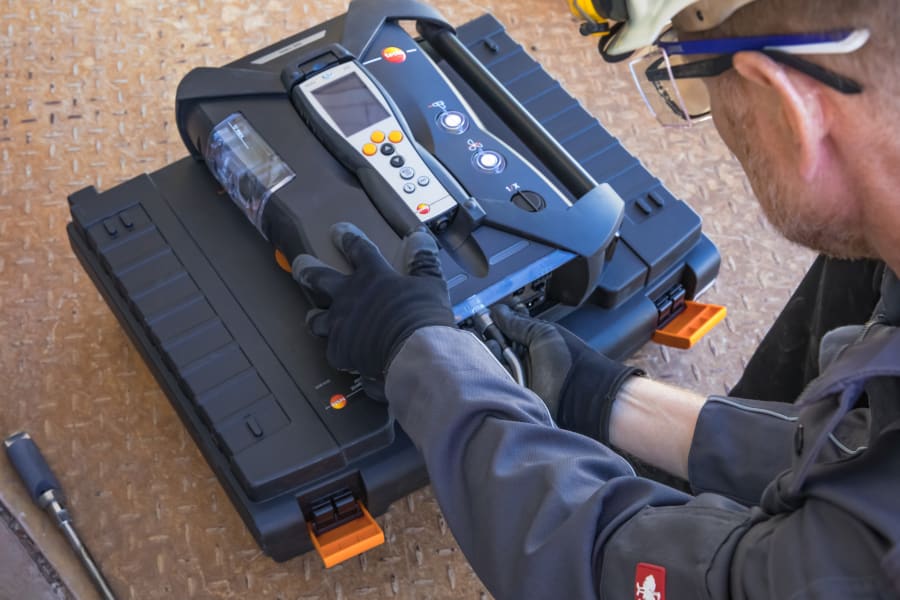
Gas conditioning components and their tasks
Gas conditioning can include different components depending on the application:
Pre-filter in the probe to separate coarse particles,
Heated hose lines for condensation-free transport,
Gas cooler and condensate drain for defined drying,
Fine filter for removing remaining particles,
Flow monitoring and pumps to ensure a stable sampling volume.
In humid, sulphur-containing flue gases, corrosion-resistant materials are important to ensure a long service life of probes and lines. In dust-intensive applications – for example in cement plants – filters must be easy to access so that they can be cleaned or replaced regularly. The right combination of components determines whether measurement systems operate stably in the long term.

Typical sources of error and how to avoid them
Condensation, dust and leaks
The most common sources of error in sampling and gas conditioning systems include:
Insufficiently heated lines with condensate formation,
Dirty or clogged filters,
Leaks in hoses and connections,
Unsuitable materials with corrosion or adsorption issues.
Practical recommendations for preventing such errors include:
Temperature monitoring of heated paths and regular functional checks,
Defined maintenance intervals for filters, probes and condensate drains,
Leak tests after modifications or maintenance,
Documenting maintenance actions and anomalies in the measurement system.
Even simple routine checks – for example visual checks for condensate, regular filter changes and functional checks of pumps – help keep measurement systems stable and avoid unplanned downtime.
Do you have questions or would you like personal advice? Contact us!
We look forward to supporting you with our expertise and individual solutions.