Directly from the manufacturer
Free delivery Australia wide
Fast delivery
Secure payment
Directly from the manufacturer
- Home
- Know How
- Thermal Imaging Camera
- Accessories for thermal imaging cameras: lenses, service & registration | Testo
Accessories and service for thermal imaging cameras:
Lenses, measurability and lifecycle

Accessories often determine whether thermography really works in the field: the right optics make a target measurable at a given working distance (IFOV), while software makes results documentable and comparable. Registration and service topics also help preserve usability over many years, especially when thermography is part of a recurring inspection process.
What does accessories add to thermography – and when is it worthwhile?
Accessories are most useful when they overcome a hard limitation: the target is too small in the image (IFOV), the scene is too large or too tight (field of view), or documentation is too time-consuming (software/app). Lenses are worthwhile when safety or access requirements prevent you from changing the distance but you need more detail on small targets. Software is worthwhile when reports and recurring inspections are essential.
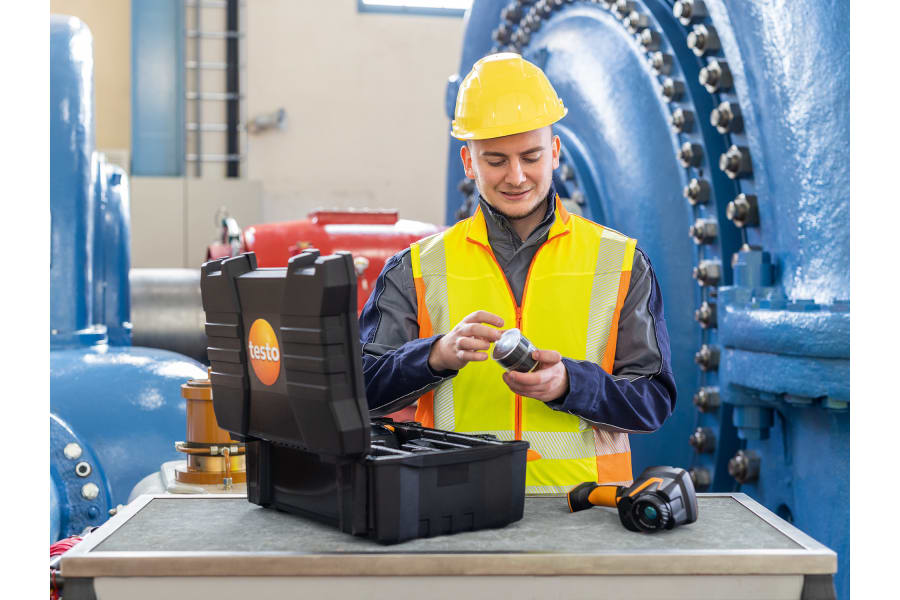
Lenses: wide angle vs. telephoto
A lens changes the field of view (FOV) and therefore how large an object appears in the image. This directly affects the measurability of small targets.
Wide angle: large areas, tight spaces
Wide-angle lenses are suitable for overviews and tight spaces where you cannot move farther back. The trade-off is that small targets appear smaller.
Telephoto: small targets from a distance
Telephoto lenses help display small targets, such as terminals or PV connections, larger from a greater distance – relevant for safety and accessibility.

Improving IFOV: imaging the target measurably
If your target is only a few pixels in size in the thermogram, a mixed pixel is created. In that case, changing to a telephoto lens can often be more effective than “measuring even more precisely”.
When changing the lens makes more sense than “moving closer”
Changing the lens is particularly useful when:
safety distances limit how close you can get,
the measurement point is difficult to access,
you repeatedly inspect many small targets.

Software as “accessories” for documentation
In many organizations, reports, image management and on-site documentation are the real drivers of efficiency.
Service & lifecycle: registration, updates and maintenance
Product registration
Registering your new thermal imaging camera within 30 days of purchase gives you a free one-year extension of the warranty for the measuring instrument.
Calibration
Calibration and regular verification are important when thermography is used as a process requiring documentation or when comparability over time matters. The specific scope depends on the application, internal quality requirements and process criticality.

Next steps: instrument selection and fundamentals
Do you have questions or would you like personal advice? Contact us!
We look forward to supporting you with our expertise and individual solutions.