1. Home
  2. testo 310

testo 310 - Basic Flue Gas Analyser 

0563 3100
testo 310
  • CO, O2 and CO2 also measures ambient CO, draught and pressure 
  •  
  • Bright backlit 2 line display and icons for easy viewing 
  • 2 year warranty 
  • Product no longer available. Have you checked out its successor?
    Why not enjoy the benefits that it has to offer: >> To the product

    The Testo 310 basic flue gas analyzer. For reliable heating system checks

    Fully featured and priced right, the Testo 310 residential combustion analyzer provides exceptional value and complete capabilities in combustion testing and furnace efficiency. With its capability to perform both basic, or more complex flue gas analysis, maintenance or safety checks, or confirm furnace efficiency, the fully featured Testo 310 combustion analyzer delivers more combustion parameters.

    The stainless steel probe and cone-stop is perfect for residential, and boiler applications. The 310 can be used for accurate heating adjustments, so you can get it right the first time - every time.

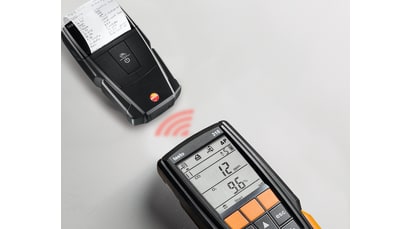
    With five different fuels to select from (Natural Gas, Propane, Fuel Oil , Biomass 5%, Wood 20%), it provides the flexibility you need for your tuning opportunities. With an optional printer kit available, you are able to keep records of all readings taken.
    What Does the Testo 310 Really measure

    O2, CO , CO2 | Undiluted CO | Ambient CO | Draft & Pressure | Temperature (flue & ambient) | Combustion/flue gas efficiency & excess air 

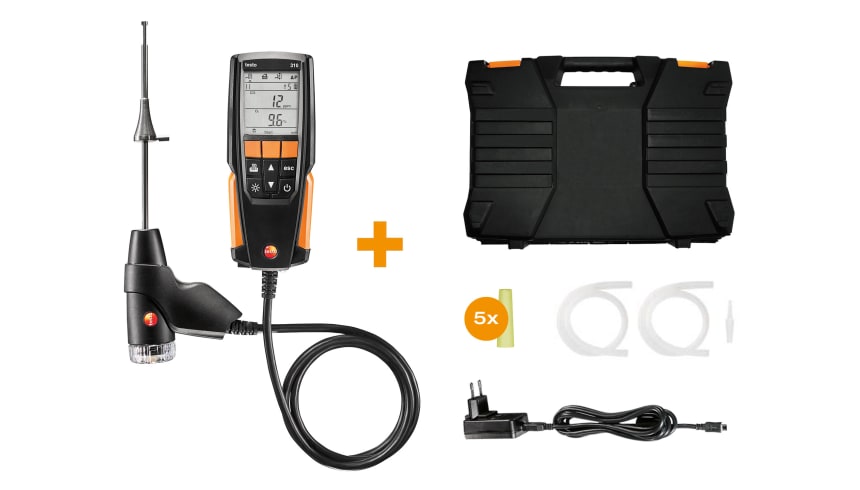
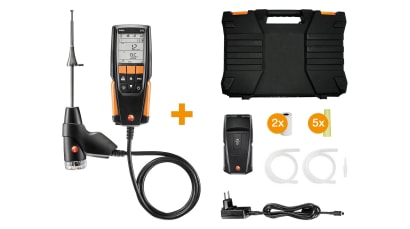
    testo 310 combustion analyzer, lithium battery, sensors, probe with cone, hose, silicon tubing (for pressure), extra particulate filters (5), AC power supply (USB), protocol certificate, & case.

    General technical data

    Weight
    (with probe) Approx. 700 g
    Dimensions
    201 x 83 x 44 mm
    Operating temperature
    -5 to +45 °C
    Display type
    LCD (Liquid Crystal Display)
    Display function
    Backlit 2-line display
    Power supply
    Battery: 1500 mAh, mains unit 5V/1A
    Storage temperature
    -20 to +50 °C

    Temperature - TC Type K (NiCr-Ni)

    Measuring range
    -20 to +100 °C
    Accuracy
    ±1 °C
    Resolution
    0.1 °C
    Reaction time
    < 50 s
    Temperature (ambient temperature)

    Temperature - TC Type J (Fe-CuNi)

    Measuring range
    0 to +400 °C
    Accuracy
    ±1 °C (0 to +100 °C)
    ±1.5 % of mv (> 100 °C)
    Resolution
    0.1 °C
    Reaction time
    < 50 s
    Temperature (flue gas)

    Accessories

  • Accessories
    Spare particle filter
    Spare particle filter, compact probe; 10 off
      :
      0554 0040
    • Accessories
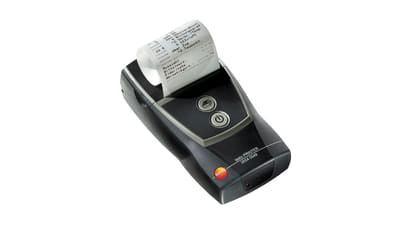
      testo-Schnelldrucker IRDA mit kabelloser Infrarot-Schnittstelle
      testo fast printer IRDA
        :
        0554 0549
      • Accessories
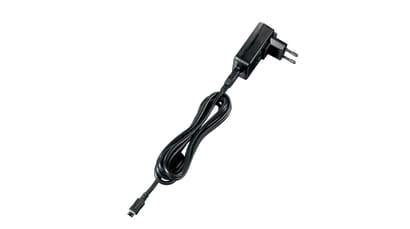
        USB mains unit incl. cable
          :
          0554 1105
        • Accessories
          testo 310 and IR Printer
          Testo IR printer
            :
            0554 3100
          • Accessories
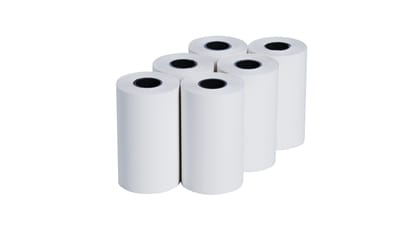
            Spare thermal paper
            Spare thermal paper, permanent ink
              :
              0554 0568
            • Draught measurement in the flue gas duct

              Draught measurement is actually a differential pressure measurement. This differential pressure occurs between two sub-areas as a result of a difference in temperature. This is turn generates a flow to compensate. In the case of flue gas systems, the difference in pressure is an indicator of the “chimney flue draught”. This is measured between the flue gas and ambient air at the measurement orifice at the core of the flue gas flow.

              To ensure the flue gases are safely transported through the chimney there must be a differential pressure (chimney flue draught) for boiler systems that work with low pressure.

              If the draught is permanently too high, the average flue gas temperature increases and therefore flue gas loss. The level of efficiency drops.

              If the draught is permanently too low, oxygen may be lacking during combustion, resulting in soot and carbon monoxide. This will also cause a drop in the level of efficiency.

              Ambient CO measurement in the heated environment

              Carbon monoxide (CO) is a colourless, odourless and taste-free gas, but also poisonous. It is produced during the incomplete combustion of substances containing carbon (oil, gas, and solid fuels, etc.). If CO manages to get into the bloodstream through the lungs, it combines with haemoglobin thus preventing oxygen from being transported in the blood; this in turn will result in death through suffocation. This is why it is necessary to regularly check CO emissions at the combustion points of heating systems, and places often frequented by people (in our case, where the combustion systems for hot water generation are), and in the surrounding areas.

              Measuring the flue gas parameters of the burner (CO, O2, and temperature, etc.)

              The flue gas measurement for a heating system helps to establish the pollutants released with the flue gas (e.g. carbon monoxide CO) and the heating energy lost with the warm flue gas. In some countries, flue gas measurement is a legal requirement. It primarily has two objectives:

              1. Ensuring the atmosphere is contaminated as little as possible by pollutants; and

              2. energy is used as efficiently as possible.

              Stipulated pollutant quantities per flue gas volume and energy losses must never be exceeded.

              Measurement in terms of results required by law takes place during standard operation (every performance primarily using the appliance). Using a Lambda probe (single hole or multi-hole probe), the measurement is taken at the centre of flow in the connecting pipe (in the centre of the pipe cross-section, not at the edge) between the boiler and chimney/flue. The measured values are recorded by the flue gas analyzer and can be logged either for print out or transfer to a PC at a later stage.

              Measurement is taken by the installer at commissioning, and if necessary four weeks later by the flue gas inspector/chimney sweep, and then at regular intervals by the authorised service engineer.

              Measuring pressure on burners (nozzle pressure, gas flow pressure, etc.)

              Standard readings taken during services of domestic heating systems include checking the gas pressure on the burners. This involves measuring the gas flow pressure and gas resting pressure. The flow pressure, also called supplied pressure, refers to the gas pressure of the flowing gas and resting pressure of the static gas. If the flow pressure for gas boilers is slightly outside the 18 to 25 mbar range, adjustments must not be made and the boiler must not be put into operation. If put into operation nonetheless, the burner will not be able to function properly, and explosions will occur when setting the flame and ultimately malfunctions; the burner will therefore fail and the heating system will shut down.

              Testo - Head Office
              Testo Pty Ltd
              Unit 11, 114-118 Merrindale Drive
              Croydon SouthVictoria 3136
              Australia
              +61 (0)3 8761 6108+61 (0)3 4100 0438
              Testo - Service Centre
              For all calibration and repair services.
              Unit 1, 10-12 Sigma Drive
              Croydon South Victoria 3136
              Australia
              +61 (0)3 8761 7108

              You can reach us by telephone during these hours:

              Mon - Fri: 9:00 - 17:00 (AEST)
              Image
              Blog

              Visit our blog

              © 2026