
Flue gas analysers testo 340 and testo 350
Maximum flexibility for emission measurements on stationary engines.

Industrial engine systems are mostly used for decentralized energy generation or as drives, for example in pumping stations in the oil and gas industry. They are characterised by changing load cycles, the use of different fuels (e.g. natural gas, biogas, sewage gas, diesel) and a complex composition of exhaust gases. Emission measurements are not only crucial for compliance with legal requirements, but also for optimizing combustion and analysing faults. The precise setting of a motor‘s operating parameters is crucial to ensuring that the system can be operated efficiently, economically and in a resource-saving manner.
Regular maintenance intervals should be adhered to in order to ensure full operational capability in the long term. The O₂ content in the flue gas enables the fuel-air ratio to be analyzed. CO and NOx values provide valuable information on the current status of the system and its adherence to the emission limit values. The complex interaction between the flue gas parameters and the combustion process settings of the engine is crucial for optimum performance. A reliable, high-precision measuring instrument is therefore indispensable for efficient operation.
The Challenge
The combustion process in stationary engines is complex and involves numerous challenges. Fluctuating operating conditions due to load changes and varying fuel qualities influence the stability of combustion. In addition, there are strict emission requirements that require precise control of pollutants such as NOx, CO and particulates, while the complex composition of the flue gases makes regulation even more difficult.
An optimum air-fuel ratio is crucial for high efficiency, as too much air reduces performance and too little air can cause emissions and component damage.
In the case of ideal (stoichiometric) combustion, the oxygen in the combustion air is just sufficient to burn the fuel completely.
this minimum amount of oxygen is not sufficient, as the mixing of fuel and air is never perfect, so an excess of air is required, the ratio of which to the stoichiometrically required amount of air is described by the air ratio λ. Too much excess air lowers the combustion temperature, causes energy losses, which reduces efficiency and leads to increased emissions of unburnt hydrocarbons.
Depending on the λ, a distinction is made between engines with a lean mixture (λ > 1) and those with a rich mixture (λ ≤ 1). The process dynamics also require stable ignition and controlled flame. An incorrect setting of the ignition timing can lead to premature ignition, which causes uncontrolled combustion processes with extreme pressure and temperature peaks. This increases the risk of misfiring and cylinder damage and further increases the formation of NOx, as high local temperatures and pressures favour the formation of nitrogen oxides. To minimise NOx emissions, correct ignition adjustment and stable combustion control are essential.
Excessively high CO concentrations indicate incomplete combustion and therefore poor efficiency, which increases fuel costs. High CO values, which can occur during adjustment work, can also damage the CO sensors of gas analyzers. Regular maintenance is therefore crucial to ensure the efficiency of the engine and prevent damage. Every service should include a flue gas measurement of the relevant parameters such as O2, CO and NOx, as they provide information on the functionality and efficiency of the combustion process.
Overall, the following applies: The complex interaction between flue gas parameters, air ratio, ignition adjustment and the combustion process settings forms the basis for optimum performance. High-precision measuring instruments are therefore essential for efficient and low-emission operation in order to reliably monitor and optimize combustion.

The solution
With the testo 340 and testo 350 flue gas measuring instruments, Testo offers two solutions that fulfil all the requirements of emission measurement on stationary engine systems. Both instruments enable precise analysis thanks to the flexible combination of different gas sensors (O₂, CO, NO, NO₂) and are characterized by their robustness, user-friendliness and simple maintenance.
The measurements are taken in front of and behind the catalytic converter:
Before the catalytic converter to optimize engine settings, improve efficiency and reduce wear.
After the catalytic converter to check the efficiency of the exhaust gas purification system and to assess emissions before official tests.
For engines without a catalytic converter, the setting must ensure that the engine complies with the legal limits for O₂, CO, NO and NO₂. As the flue gas measurement is the only control of emission conformity, it is of particular importance.
The testo 340 and testo 350 flue gas measuring instruments offer a precise solution for the complex challenges of the combustion process in stationary engines. They measure all relevant flue gas parameters such as O₂, CO, NO and NO2 and thus enable combustion to be analyzed precisely. This is crucial for increasing efficiency, reducing emissions and complying with legal limits. Thanks to their robust design and heat-resistant engine probes, the instruments can also be used reliably under the prevailing pressure and temperature conditions.
As ideal stoichiometric combustion cannot be achieved in practice, a controlled excess of air is necessary. The measuring instruments provide precise data on the air ratio (λ) and enable the mixture to be set precisely - whether lean (λ > 1) or rich (λ ≤ 1). This ensures that combustion is optimized depending on the engine type, energy losses are avoided and the efficiency of the engine remains optimal. Special low gas sensors provide exact values even for very low gas concentrations.
An incorrect ignition setting can lead to premature ignition, extreme pressure and temperature peaks, and increased NOx formation. The flue gas measuring instruments recognise such deviations based on the NOx values and provide the basis for precise adjustment of the ignition timing. This prevents misfiring and cylinder damage, extends engine life and significantly reduces emissions. The automatic CO dilution function protects the sensors during peak values and enables uninterrupted measurements, even during adjustment work.
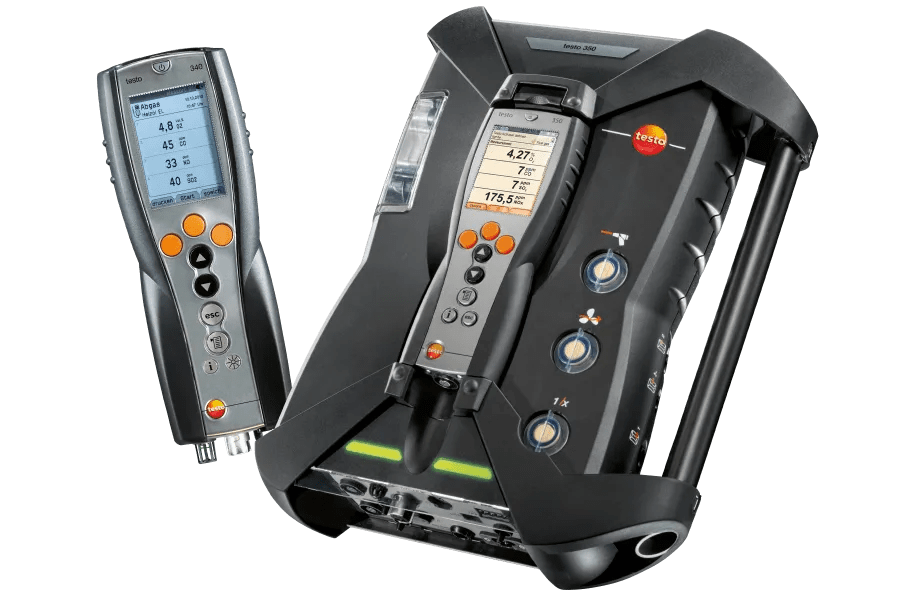
The advantages at a glance.
With the high-precision testo 340 and testo 350 flue gas analyzers, you can ensure the efficient operation of stationary engines and reliably monitor compliance with emission limit values.
Automatic dilution function protects CO sensors from overload during high CO peaks and extends the measuring range so that measurements can be continued without interruption.
Heat-resistant engine probes compensate for different pressure ratios, which occur in particular during measurements before and after the catalytic converter.
High measurement accuracy at low concentrations, thanks to precise COlow and NOlow sensors
Integrated gas conditioning (with testo 350) enables measurement in dry flue gas, as required for comparative measurements with official measurements.
Ready to measure in 30 seconds
Intuitive operation with practical measurement menus and useful instrument pre-settings
Easy, precise test gas adjustment on site by the user
Robust housing for use in rough surroundings
Pre-calibrated sensors can be exchanged in the field, thus reducing downtimes. The instrument does not need to be sent in for a sensor replacement.
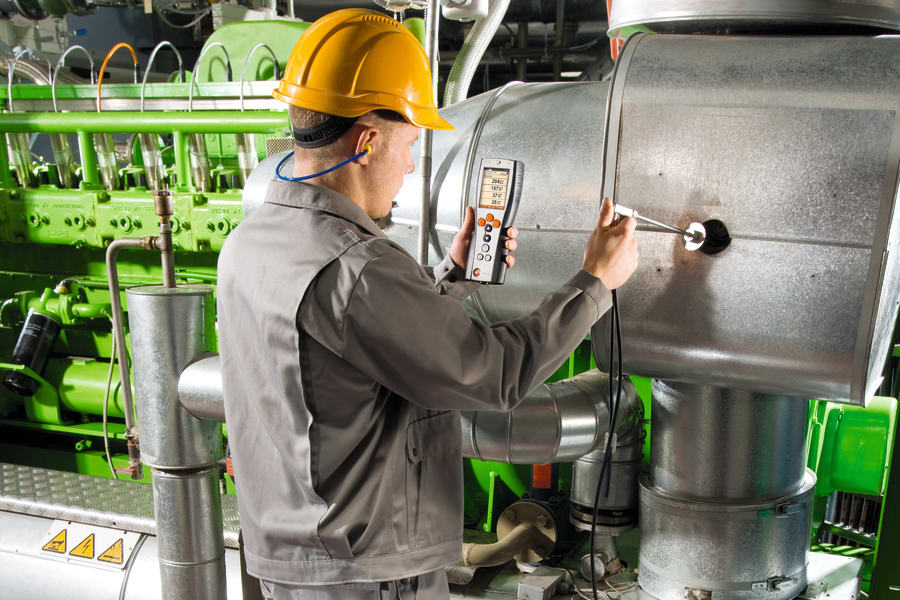
The flue gas analysers in comparison
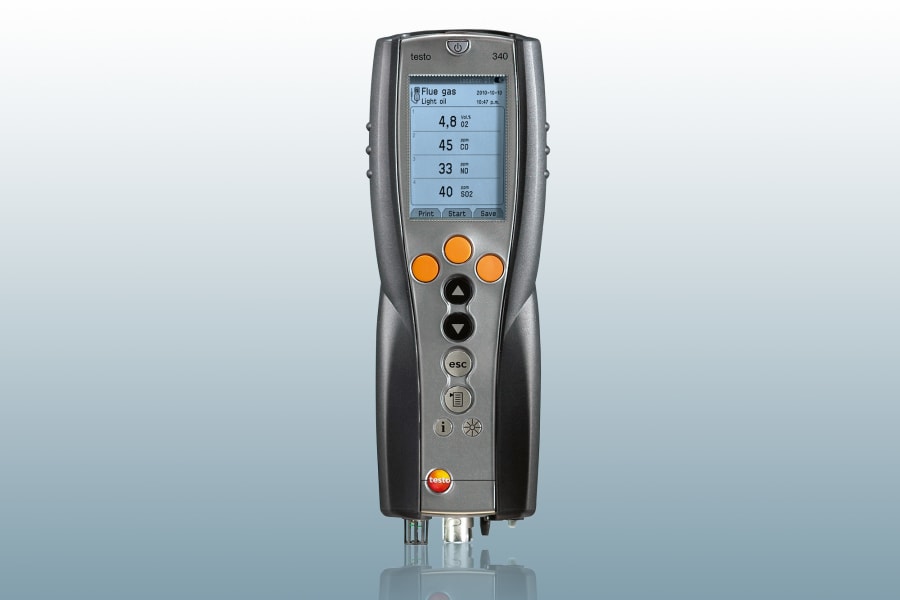
testo 340
Measurement parameters: O2, CO, COlow, NO, NOlow, NO2, SO2
Sensor parameters: up to 4
Long-term measurements: Short to approx. 2-hour measurements
Measuring range extension: Single slot: x5, All slots: x2
Gas cooler: External gas cooler possible
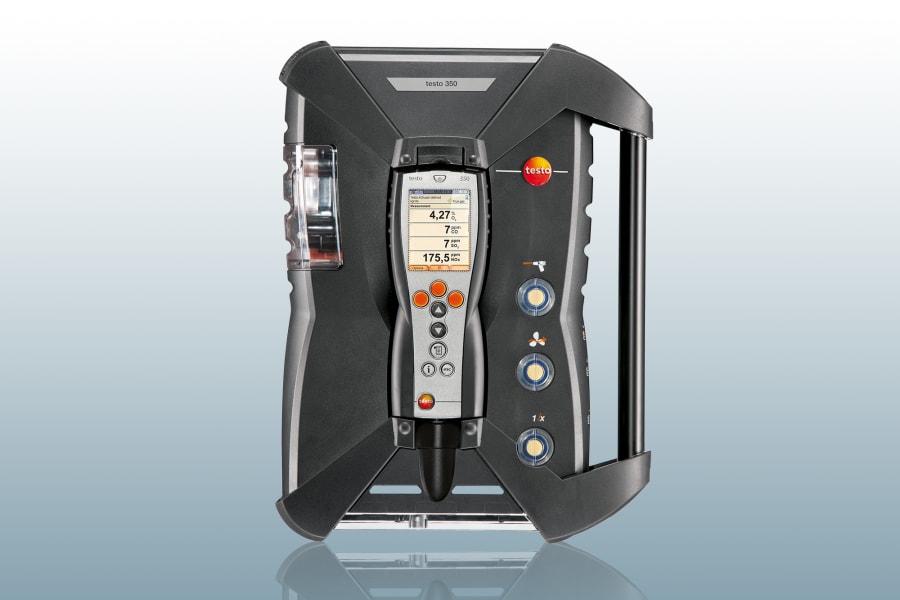
testo 350
Measurement parameters: O2, CO, CO2, COlow, NO, NOlow, NO2, SO2, SO2low, H2S, CxHy
Sensor parameters: up to 6
Long-term measurements: Measurements over several days
Measuring range extension: Single slot: x2, x5, x10, x20, x40, All slots (with fresh air valve): x5
Gas cooler: Optionally with integrated gas cooler
At Testo, we’re here for you
Do you have any questions about applications, configuration or support? At Testo, we’re happy to help.