Stationary temperature monitoring
Why temperature monitoring is a management task
Three approaches: spot checks, data loggers, automated monitoring
2026-07-09
Temperature limit values are defined in many companies – nevertheless, deviations often arise not because of a lack of limit values, but because of a lack of visibility and responsiveness. Monitoring is therefore less a measurement question than a management question: Who detects a deviation, who is informed, who decides and how is the measure documented?
In practice, three approaches can be distinguished:
Spot checks provide a snapshot and are a quick start but leave events between two measurements invisible.
Although data loggers generate complete data, they are often evaluated with a time delay, so that reaction times suffer.
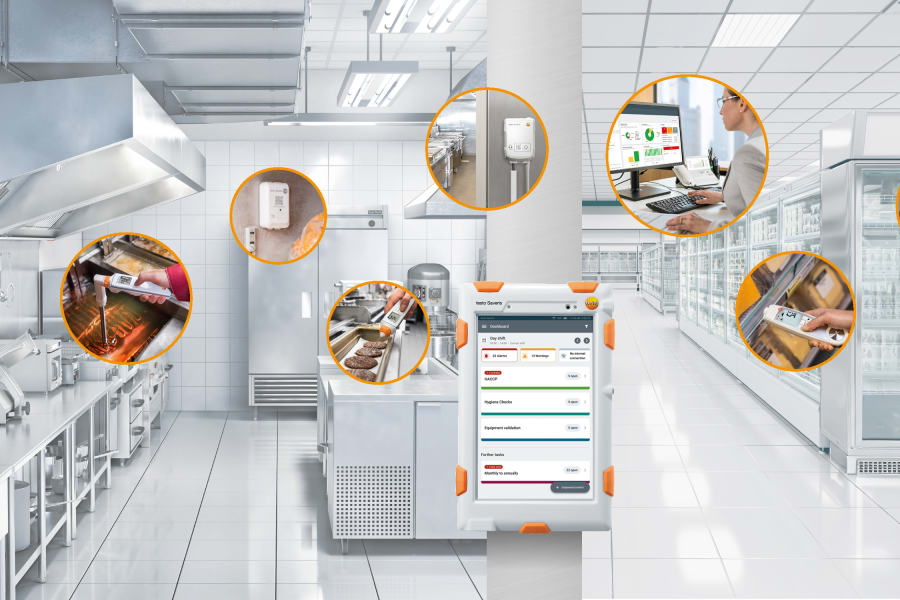
Automated monitoring systems combine continuous recording with central evaluation and alerting; they reduce media discontinuities but require a resilient alarm and rollout concept.
Alarm design as a core competence: relevance instead of a flood of alarms
The benefit of a monitoring system only arises from a good alarm design. Four elements are central: First, threshold values and measurement intervals must fit the process. Second, delay logics are important to avoid treating short peaks as critical events. Thirdly, escalation chains are needed that also work in the event of illness, holidays or night operations. Fourth, alert classes should be introduced so that teams can prioritize. Without these elements, monitoring quickly creates alert fatigue and loses acceptance.

Implementation in multi-site companies: standardization, templates and rollout waves

In multi-site companies, standardization is the most important success factor. Location types (e.g. small/medium/large) with associated measuring point and limit value templates are recommended. A pilot is used to check alarm quality and operability before the rollout takes place in waves. At the same time, an operating model should be defined: Who maintains limit values centrally, who reviews data, who closes deviations and how are reports made available for audits?
Complex locations (production/logistics): Securing zone logic and interfaces
In production and logistics environments, the "one-size-fits-all boundary" is rarely sufficient. Different zones (goods receipt, buffer, production, shipping) require differentiated thresholds and escalation rules. Interfaces are particularly critical: handovers between teams or service providers as well as shift changes. A monitoring concept should explicitly address these handovers so that responsibilities do not "seep away" in the process.
Typical Risks of Manual Documentation: Why "Paper" becomes vulnerable in Audits
Many organizations still document temperatures on paper or in manually maintained tables. This is possible in principle, but in practice it is weakened by error patterns: omission of measurements, transcription errors, subsequent entries or missing documentation of measures. From an audit perspective, this creates not only a data problem, but also a governance problem: It is unclear whether the process is actually being lived or is only formally documented.
find out more