Temperature control in incoming goods:
standardization, measurement methodology and documentation for many locations
Classification: Why Goods Receipt is a Critical Control Point
2026-05-25
Imagine, it's 7 a.m. The refrigerated truck is at the dock. Two employees are handling delivery, storage, temperature checks and documentation at the same time. This is exactly where food safety risks begin. At the interface between supplier and operator, responsibility for the product quality changes. Therefore, incoming goods are the most critical control point in the entire cold chain: If the temperature control is already violated during takeover, risks can continue along the further process chain. And it’s exactly where auditors look first. Yet across many locations, the same preventable mistakes happen every day. Not because of missing equipment, but because of missing standards. In this article, you'll learn how to build a temperature control process at goods receipt that works consistently across 5, 50 or 500 locations.
Air temperature vs. product temperature: why the difference matters
In practice, "temperature" is often treated as a single measurand. However, the distinction between air temperature (e.g. in the vehicle or in the incoming goods zone) and product temperature (surface or core) is crucial for reliable decisions.
The air temperature tells you whether the cooling system in a vehicle or storage area is working properly. Product temperature tells you whether the product itself is actually safe. And both values can differ significantly: a refrigerated truck may show the correct air temperature while the individual products near the truck door have already warmed up sometimes by 3 to 5 °C within just a few minutes. Conversely, a product can still be within the permissible range at its core, even though the ambient air fluctuates for a short time.
For the assessment of a delivery, it is always necessary to define which product temperature (surface or core) serves as the basis for decision-making and how this is practically collected in incoming goods. Air and ambient temperatures are primarily relevant as a supplement to process monitoring and for the classification of risks (e.g. cold room/vehicle), but do not replace product-specific assessment.
Measurement methodology in three stages: fast, non-destructive and conclusive when it counts
A common problem in incoming goods is the trade-off between speed and measurement of quality. Core temperature measurements are considered particularly meaningful but are not always possible without packaging damage. At the same time, pure rapid measurements only provide an overview but cannot resolve borderline cases. But speed and accuracy don’t have to be the opposite. The key is to know which measurement method to apply, and when.
Following three-step procedure that you can define in your Standard Operating Procedure (SOP) for each product group has therefore proven to be effective:
First – Quick surface scan
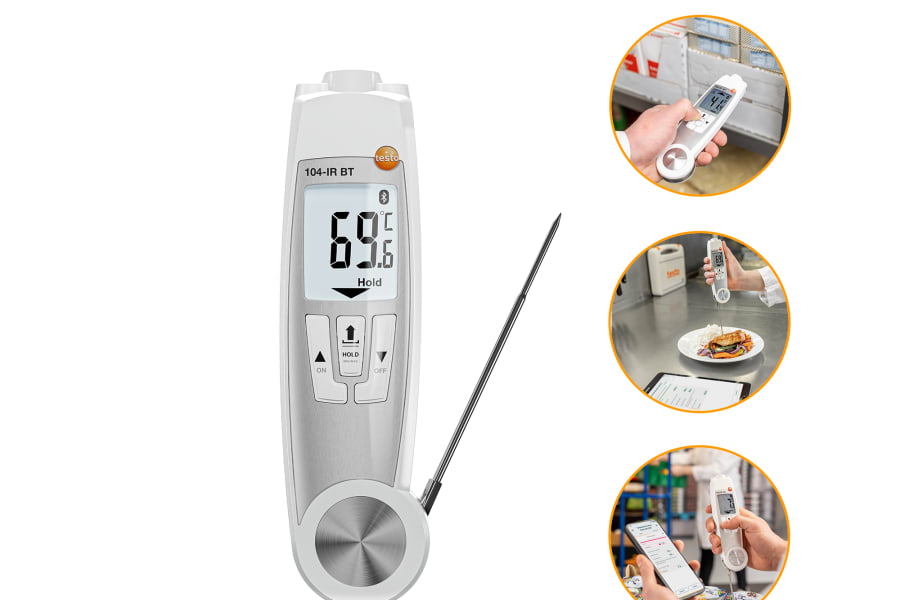
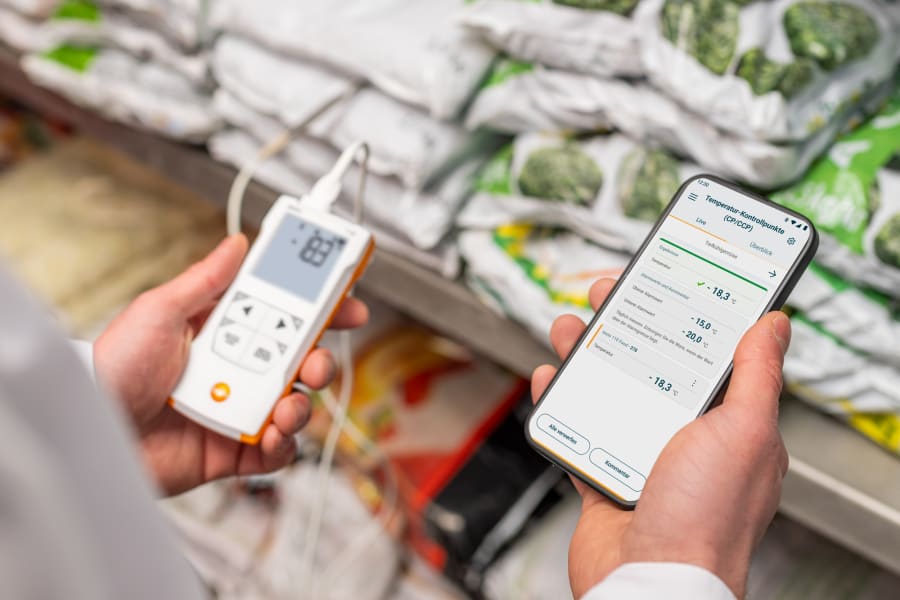
Start with a non-contact infrared measurement across the delivery. This takes seconds, identify outliers immediately and tells your team where to focus the attention.
Secondly – Verify measurement (non-destructive)
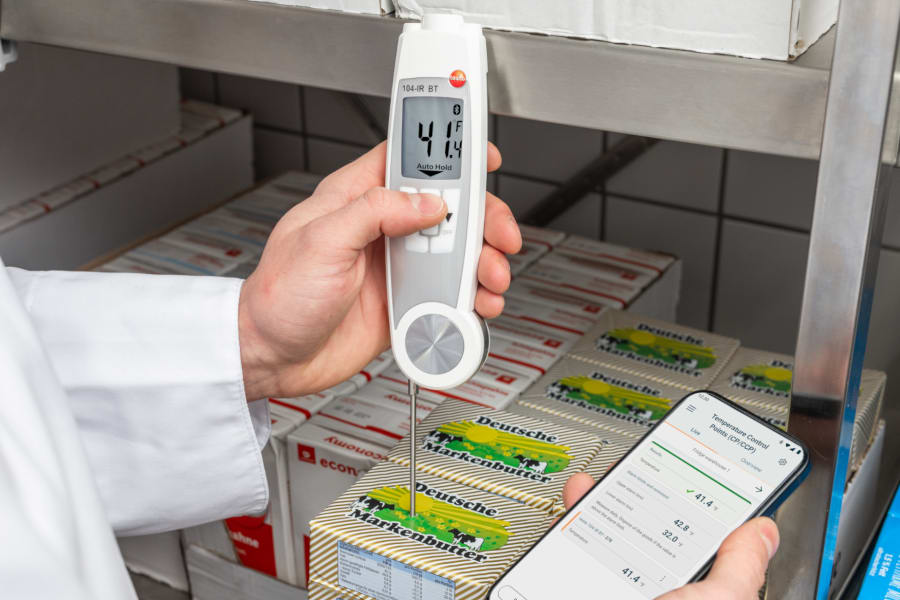
For values near the limit range, follow up with a verifying, preferably non-destructive contact measurement. Define typical points where to measure e.g. at the packaging surface or between the products. This step helps to spot borderline cases without destroying the product or opening the package.
Thirdly – Core temperature
The core temperature measurement is the only method where the real product temperature can be determined. So, it is reserved for cases where deviations in the steps before needs to be documented, escalated or used as the basis for a complaint. This step is invasive but conclusive.
What makes this system work is not the individual method, it’s the standardization around it that ensures reproducibility: Measuring points, measuring distances, measurement duration and interpretation should be standardized in such a way that different teams at different locations can achieve comparable results.
SOP as the operational backbone: Five-step process
For branch networks and multi-site organizations, an SOP is effective when it makes decisions easier and does not generate "more paper". A SOP will only work if people follow it under real conditions, affected by time pressure, staff change or peak hours. Here's a 5-step framework you can adapt directly for your incoming goods SOP:
1) Visual and document inspection upon delivery: Delivery note, product group, packaging condition and potential temperature indicators (e.g. condensate, thawed goods) are digitally recorded.
2) Risk-based prioritization: Product groups with high temperature sensitivity are first checked using a defined measurement method, and the measured values and method are digitally documented
3) Decision against limit value: release, release with condition or blocking.
4) Deviation management: Immediate measures (e.g. separation), escalation and complaints via fast routes to purchasing and quality management so as not to jeopardize profitability
5) Completion of documentation: Delivery reference, time stamp, responsibility, result and action are stored in full.
The rule of thumb for multi-site rollout: if a new employee can follow this process correctly on day two without asking for help, the SOP is well designed. Otherwise, simplify the process further.
Typical error patterns in practice – and why they occur systematically
Many deviations are not caused by a lack of technology, but by systemic everyday effects. These include skipped measurements (delivery pressure, peak times, understaffing), subsequent entries (lack of recording routine, values are filled later from memory), inconsistent measuring points (gaps in training or missing on-site reference) or incomplete corrective measures (unclear responsibility and undefined escalation). These errors are particularly relevant in branch networks because they multiply with a high number of locations.
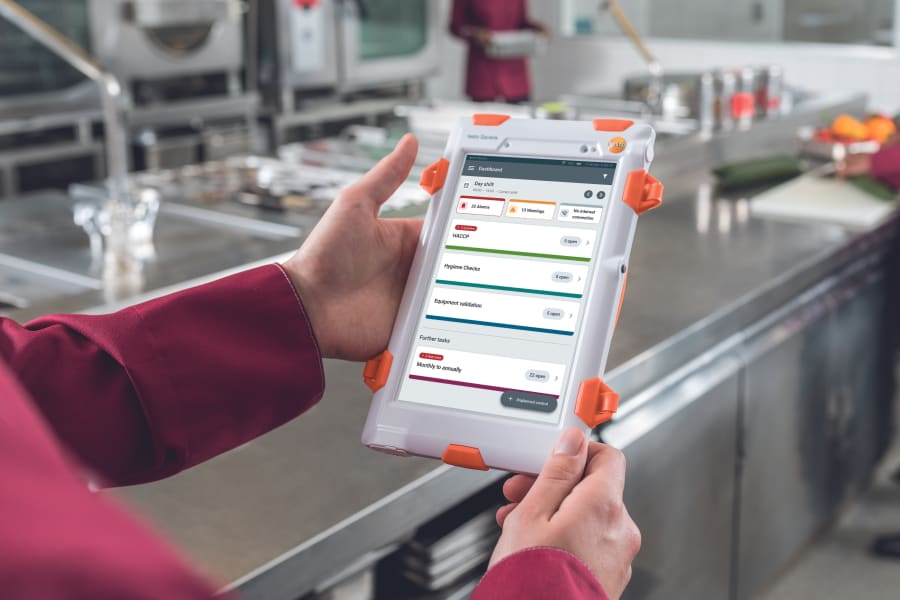
An effective solution is a purposefully simplified documentation design: minimal mandatory fields, pre-defined selection options and a clear deviation logic with exactly one next step per scenario. The less room for interpretation in the process, the higher the data quality and thus the auditability.
Measuring equipment management: calibration, plausibility and measurement environment
Process quality and measurement quality are not the same. Even with a well-designed SOP and a trained team, measurements can be falsified if measuring equipment has not been verified or measurement locations are chosen inappropriately. Those factors consistently undermine measurement reliability, even when everything else is in place.
Regular testing or calibration of the measurement equipment ensures correct readings and contribute to comparability across locations. In addition, you should consider environmental factors: Temperature gradients near surfaces, cold air outlets or draughts can create local temperature anomalies and don’t reflect actual product or ambient conditions. For air measurements, it is therefore advisable to select representative measuring points that are not directly dominated by cold air flows.
So, when an auditor questions a reading, the answer is a calibration certificate and a defined measuring point.
Conclusion
Temperature control at goods receipt is not a documentation exercise; it's a decision system. The right measurement method, a lean SOP, and verified equipment don't just protect you in audits. They protect the product, the consumer, and your brand every single day, across every single location.
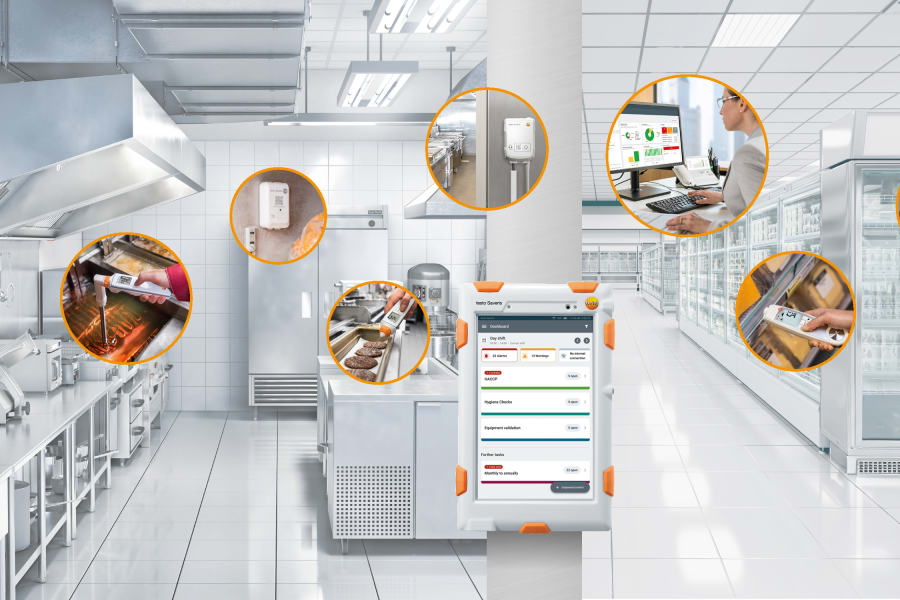
Ready to standardize your incoming goods process? Discover how testo Saveris Food helps you stay in control across every location.
find out more