- Home
- Company
- News Events
- Public Relations
- Case study - Environmental monitoring with testo Saveris 1: Seamless data in GxP-compliant processes
CASE STUDY
Environmental monitoring
with testo Saveris 1
Seamless data in GxP-compliant processes
Reliable environmental monitoring requires more than just precise measurement technology. Continuous data availability, flexible scalability, and the structured integration of new areas are equally crucial.
A practical example from the biotechnology sector illustrates how a system has developed over the years from laboratory use into a site-wide, audit-ready infrastructure.
When it comes to quality assurance in regulated areas, it is not only the accuracy of individual measurement values that counts, but above all their long-term availability. At the biotechnology company Jungbunzlauer in Ladenburg, Germany, the testo Saveris 1 environmental monitoring system has been in continuous use since 2010 – an important prerequisite for seamless documentation in GxP-compliant processes. It records temperature and humidity data via networked measurement points, stores it centrally and automatically reports deviations. The manufacturer uses it to monitor laboratories, quality control, warehouses, reference sample rooms and critical control points in production.

In biotechnology, GxP-compliant processes require precise measurements and comprehensive documentation.
Jungbunzlauer Ladenburg GmbH manufactures biodegradable ingredients, such as citric acid, xanthan and gellan for industries including food and beverage, nutrition and health, household products and personal care. According to Dr. Jochen Jung, Head of Quality Control, one of the key advantages is access to historical data: “I can scroll back through the system and access the original data at any time, at least for the sensors that are still in use.” This allows Jung to trace the conditions under which products were manufactured, stored or tested. Comprehensive documentation forms the basis for audits and regulatory compliance. Regulatory inspections are a routine part of operations, making data integrity and continuous availability essential requirements.
From the laboratory to the infrastructure
Jungbunzlauer’s journey into digital environmental monitoring began in 2010 in the laboratory. The system was expanded step by step. Additional data loggers are now used to monitor containers, silos, retention sample rooms, as well as refrigerated storage units and drying cabinets, amongst other things.
testo Saveris 1 now covers large parts of the site and fulfils various requirements simultaneously: in production and storage, the system triggers automatic alarms if temperature or humidity thresholds are exceeded. In the laboratory, on the other hand, it enables stable, reproducible conditions – for example, when temperature-controlling reagents. Materials that must be stored at a constant 25 °C are placed in monitored water baths with specially adapted sensors.
“This makes our work much easier,” explains Jung. “We no longer have to perform manual calculations and receive clean comparative values.”

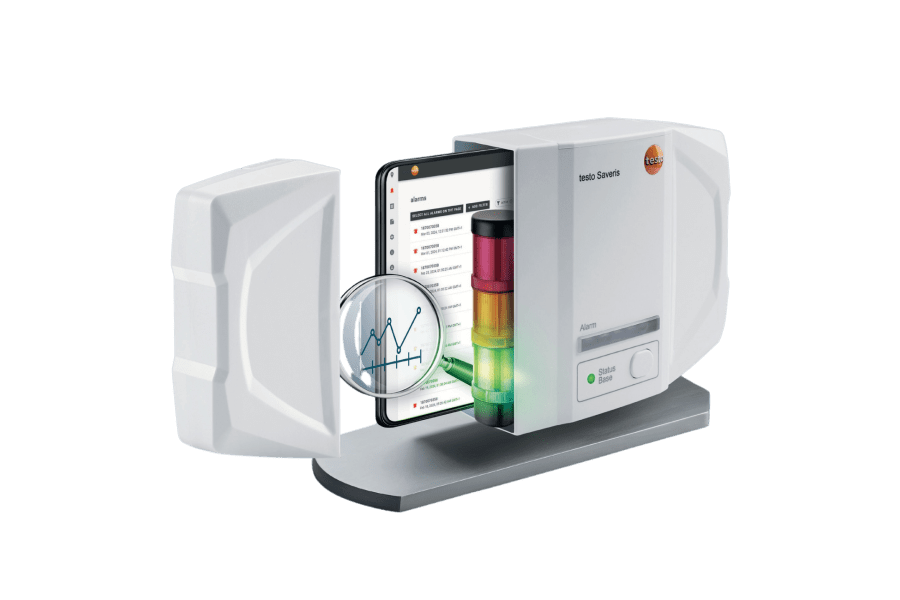
Reliable monitoring of temperature and humidity: The testo Saveris 1 environmental monitoring system provides continuous data over many years.
Expansion and system architecture
The system was further expanded as part of the construction of a new bottling hall in 2025. The new area, covering around 2,500 square metres, required additional measurement points as well as a review of the overall system architecture. This process was based on a detailed assessment:
How many data loggers are needed?
Which components can be reused?
Where are modifications needed to ensure GMP-compliant validation?
And how can the infrastructure remain scalable in the long term?
Together with Testo, Jungbunzlauer analysed how the requirements could be implemented in practice. The result is a standardised system architecture with planned redundancy.
Jochen Jung explains: “We are now significantly more flexible, as connectivity can provided via both Wi-Fi and radio communication.”
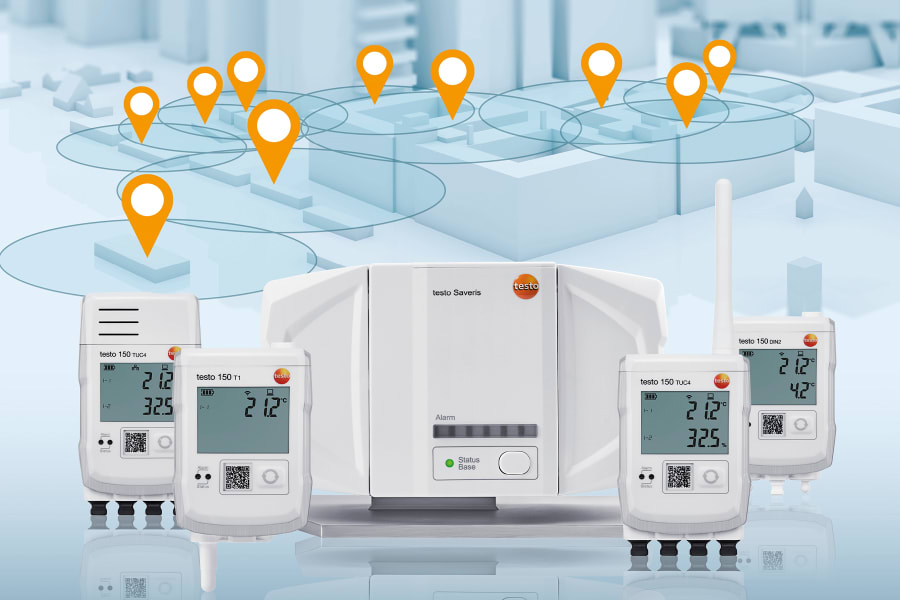
The data loggers used at Jungbunzlauer are designed to suit different measurement tasks – ranging from integrated temperature sensors to multi-channel devices for external sensors.
Data-driven planning
The integration of the new bottling hall also follows a systematic approach. Prior to the final installation, the service technicians carried out a mapping exercise lasting several days to record climatic variations within the hall. To this end, they temporarily installed 26 sensors, which recorded temperature and humidity data over a ten-day period. On this basis, the optimal positions for the permanent sensor system could be defined – supplemented by additional measurement points on the individual filling lines.
The result: a needs-based sensor layout instead of a one-size-fits-all approach to sensor deployment. In large-scale production environments, this is a major advantage.
Operation and further development
In addition to the technical infrastructure, day-to-day operations are also crucial. Testo’s service engineers regularly calibrate the sensors in use to ensure long-term measurement accuracy. At the same time, the system demonstrates its flexibility in day-to-day operation: “We also find creative solutions – for example, when a sensor is installed high up in a high-bay warehouse and the reference sensor needs to be positioned using a forklift,” explains Jung.
With the expansion of the filling hall, the development of the monitoring system at the site is not yet complete. Further areas, new laboratory sections or additional production lines can be integrated at any time. “I’ve learned that it pays to ask,” concludes Jung. “For many requirements, suitable solutions already exist and can be implemented immediately.”
Anyone wishing to delve deeper into GxP-compliant environmental monitoring and structured system planning will find practical guidelines and specific implementation recommendations in the white paper from Testo Saveris GmbH.

Dr Jochen Jung, Head of Quality Control at Jungbunzlauer Ladenburg GmbH, appreciates that the new system allows him to access historical data at any time.
Key Advantages of testo Saveris 1 at a glance
Provides continuous measurement data over extended periods – essential for audits and compliance
Monitors all areas centrally within a single system
Connects measurement points flexibly via radio communication or Wi-Fi
Can be expanded easily as requirements grow
Automatically alerts users to deviations and limit violations
Ensures measurement accuracy through regular calibration
Stores data locally, without requiring a cloud connection