
- Home
- Know How
- Emission Measuring Instrument
- What is an emission measuring instrument? Basics & applications | Testo
What is an emission measuring instrument?

An emission measuring instrument is a measurement system used to reliably capture, evaluate and document gaseous pollutants and particles in flue gases – such as O2 in Vol.-%, CO, CO2, NOx or SO2 in mg/m3 – so operators can prove compliance with emission limit values, set up plants efficiently and meet environmental requirements. It therefore forms the technical basis of any standards-compliant emission measurement.
Definition and core task
Emission measuring instruments are used wherever flue gases are released during combustion processes or industrial procedures. Their core task is to
capture relevant gas components and, if required, dust content in the flue gas flow,
provide measured values in standards-compliant units (e.g. mg/m3 under defined reference conditions),
check compliance with legal limit values and internal targets,
document measurement data in an audit-proof way.
Unlike simple flue gas or indoor air measurements, emission measuring instruments focus on environmental and emissions protection requirements. Measured values must therefore be not only technically correct, but also legally interpretable. This includes defined reference conditions (e.g. reference oxygen content), clearly assigned measuring points and traceable measurement procedures.

Structure of an emission measuring instrument
An emission measuring instrument generally consists of several functional units that together form a measurement chain:
Sampling: taking the flue gas from the flue gas flow, usually via a heated probe at a defined measuring point.
Gas conditioning: conditioning the flue gas, e.g. drying, dust separation and temperature adjustment, so sensors can work reliably.
Analyser: sensors or measurement cells for determining gas concentration using NDIR, electrochemical or paramagnetic methods.
Evaluation & documentation: displaying, storing and outputting measured values, including averaging and reporting functions.
In a typical system, the hot flue gas is taken via a heated probe and fed through a heated line into a gas conditioning unit. There, condensate and dust are separated before the conditioned gas enters the measuring chambers. Sensors such as NDIR measurement cells for CO and CO2 or electrochemical cells for O2, NO, NO2 and SO2 convert the chemical composition of the gas into electrical signals from which concentrations are calculated.
Depending on the application, different components are combined. In compact, mobile instruments, sampling, gas conditioning and analyser are integrated into a portable housing. Stationary systems, by contrast, consist of permanently installed probes, an analyser house and a data connection to control systems.

Typical applications in practice
Emission measuring instruments are used in many industries, including:
in boiler and combustion systems to monitor O2, CO, NOx and dust,
in glass, cement and steel plants to monitor emission-relevant process gases,
in combined heat and power plants to check NOx and CO limit values,
in waste incineration and industrial combustion plants for continuous emission monitoring.
From boiler systems to CHP plants
In a gas-fired boiler system, an emission measuring instrument typically measures O2, CO and NOx values in the flue gas to evaluate both efficiency and compliance with limit values. In a CHP plant, similar components are measured, but often under varying load conditions and different fuel qualities. In cement or glass furnaces, high dust and temperature loads also play a role, placing special demands on sampling and gas conditioning.
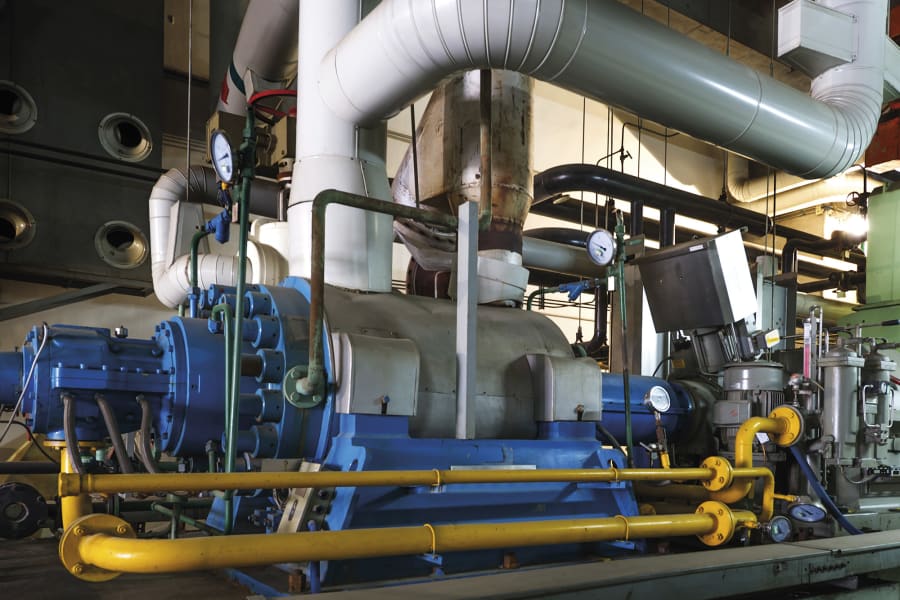
Mobile vs. stationary emission measuring instruments in comparison
Mobile emission measuring instruments are designed for flexible use at changing measuring points. They are mainly used for
commissioning and service work,
periodic inspections and spot checks,
comparative measurements at different plants
. They combine multiple sensors in a compact device and make it possible to evaluate and document measurement values directly on site.
Stationary emission measuring systems, on the other hand, are permanently installed at a measuring point and designed for continuous measurements. They are primarily used when regulations require uninterrupted monitoring and automatic documentation—for example in large combustion plants or energy-intensive industries. Such systems typically feature automatic zero and span checks, fail-safe gas conditioning and a direct connection to control systems.
For many operators, mobile and stationary technology complement each other: stationary systems provide continuous values in ongoing operation, while mobile emission measuring instruments are used for additional checks, comparative measurements or temporary measurement tasks.
Do you have questions or would you like personal advice? Contact us!
We look forward to supporting you with our expertise and individual solutions.