Testo official store
Free delivery
Secure payment
Testo official store

Moisture meters
- Indispensable for many applications

A moisture meter is used whenever the moisture content in the air or solids needs to be measured accurately. One of the most common applications is measuring the humidity in the air with a hygrometer. This is important for two main reasons:
Excessively low humidity in rooms where people are present can have negative health consequences. The reason: the low humidity dries out people's mucous membranes. As a result, our respiratory tracts become irritated and more susceptible to pathogens.
Excessive humidity can encourage mold growth in rooms. Regular ventilation and heating in winter is particularly helpful here. And, of course, checking with a moisture meter
Always use the humidity meter in the middle of the room and at chest height
Swivel the probe in gentle movements
Caution: Your breath must not falsify the result
Measuring devices for air and material moisture
Reliable brand quality
Various models for all requirements
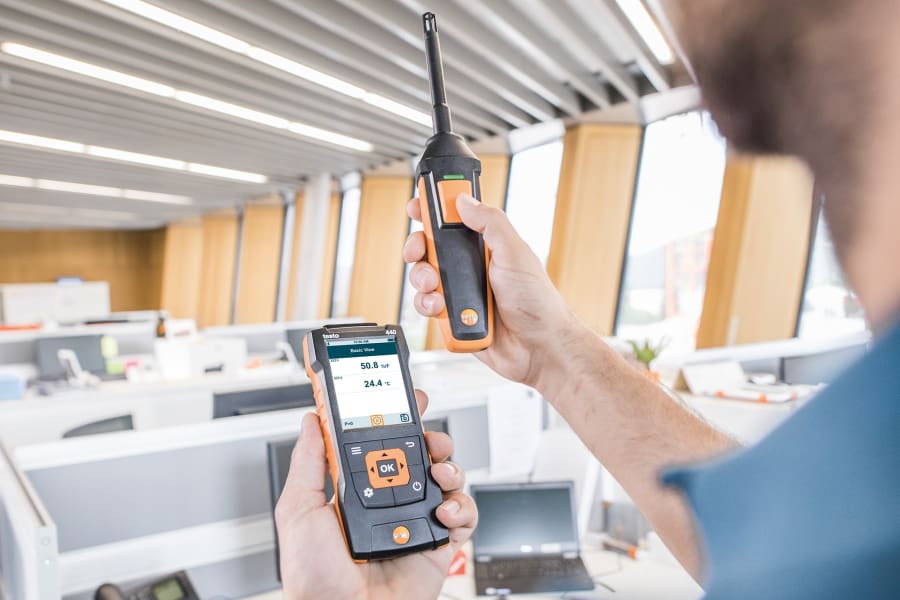
Our moisture meters and hygrometers
Where do you want to measure humidity?
The technology for measuring humidity
A moisture meter from Testo will usually accompany you for several years. So it can't hurt to know how accurately these devices measure and function.
Measuring methods for humidity measurement
Theoretically, there are over 30 methods that can be used to measure humidity. In practice, however, far fewer methods have proven to be highly reliable, easy to use and sufficiently accurate. These methods can be divided into four groups.
This group includes the hair hygrometer, the oldest and best-known measuring method for determining humidity. This is how it works: Human or horse hair (but also the synthetic fibers now used) change their length by up to 2.5 % when they absorb moisture. This change in length is indicated mechanically on a scale.
A damp object cools down when air is blown onto it. As a result, the temperature around the evaporation point is lower than the ambient temperature. And so-called psychrometers make use of this fact to measure humidity.
With this measuring principle, sensors are used to measure humidity. With lithium chloride sensors, for example, the electrical conductivity of a surface coated with lithium chloride is measured. This allows conclusions to be drawn about the humidity, which is then displayed as measured values.
This process uses the cooling of moist air until condensation appears on a tempered mirror. And the temperature that prevails when the mirror starts to fog up is the dew point temperature.
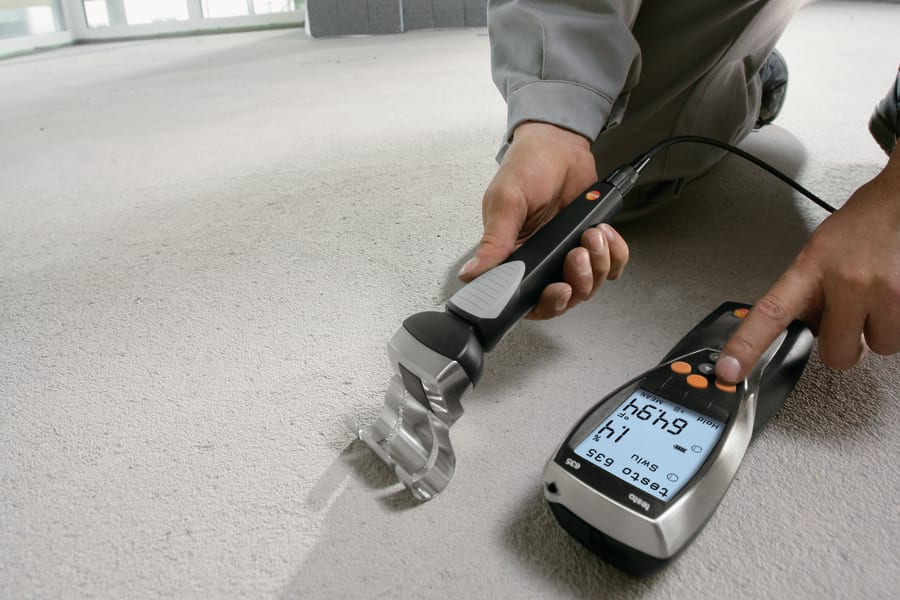
Other measuring devices for moisture measurement
In addition to a moisture meter, you will of course also find many other measuring instruments for measuring moisture and humidity at Testo. Because not all moisture is the same and different applications require different measurement technology. You can choose whether you want to measure humidity or material moisture and whether you want to record measured values over a longer period of time.
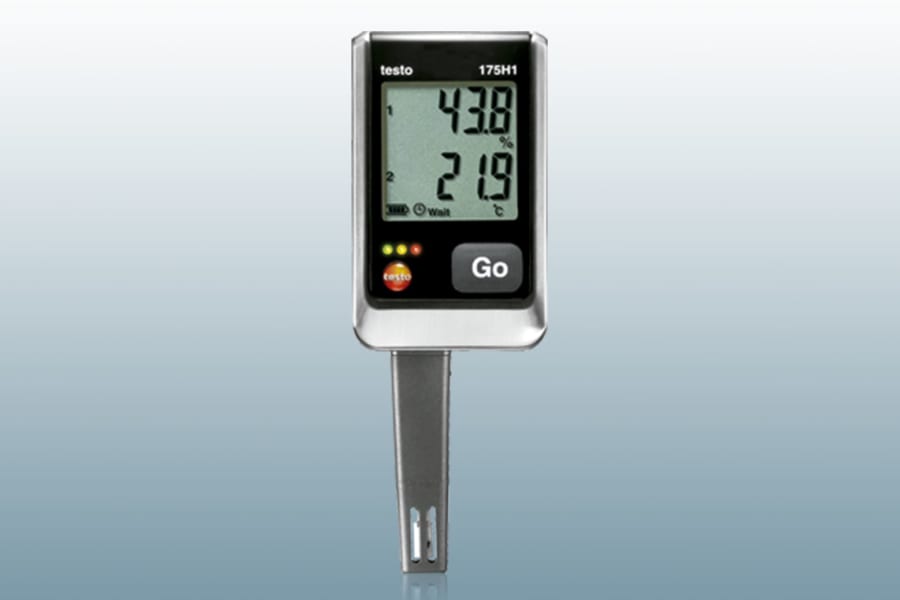
Testo offers humidity data loggers to solve measurement tasks where a point-by-point measurement of humidity is not sufficient. These measure and document the humidity at individual measurement intervals. This allows you to quickly see how the humidity has developed when analyzing the measured values on your PC later on.
If you only need to measure humidity at certain points, a humidity meter is still the best choice. Quick to use, easy to use and precise in its measurement - so you have the humidity under control.
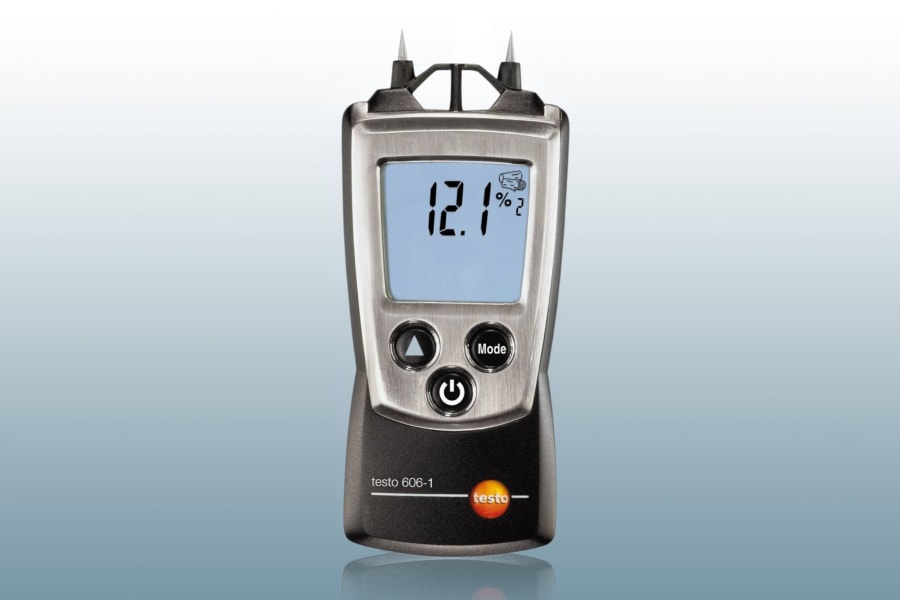
Moisture must not only be measured in the air - this is also necessary in solid materials. In the building trade in particular, it is crucial that certain materials are sufficiently dry before further processing. And with a material moisture meter from Testo, you can complete this task quickly and accurately.
As you have already seen, there are many different terms for the moisture meter. And the frequently used humidity indicator is just one of them. Basically, it also refers to a hygrometer or moisture meter.
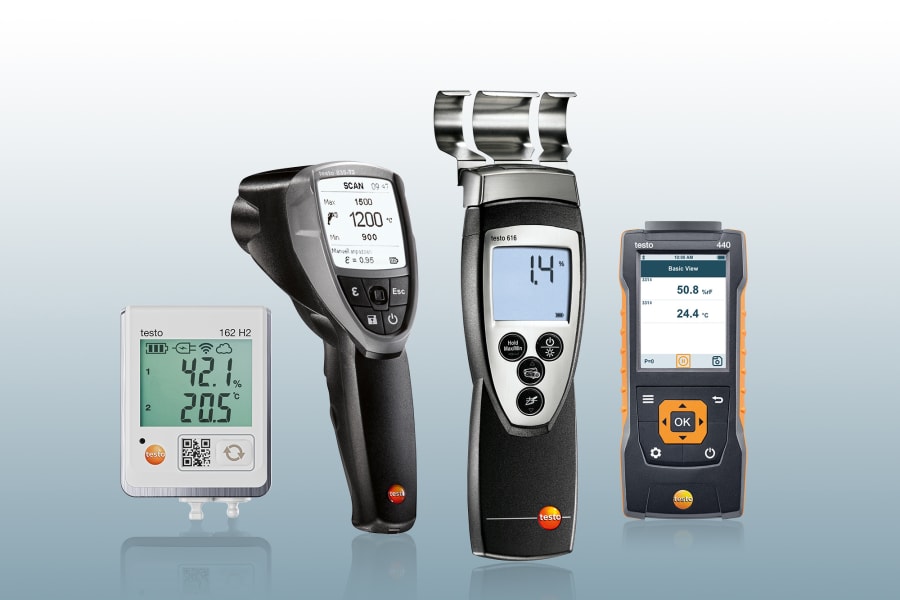
Other measuring devices
Bestseller
Moisture data logger
Bestseller
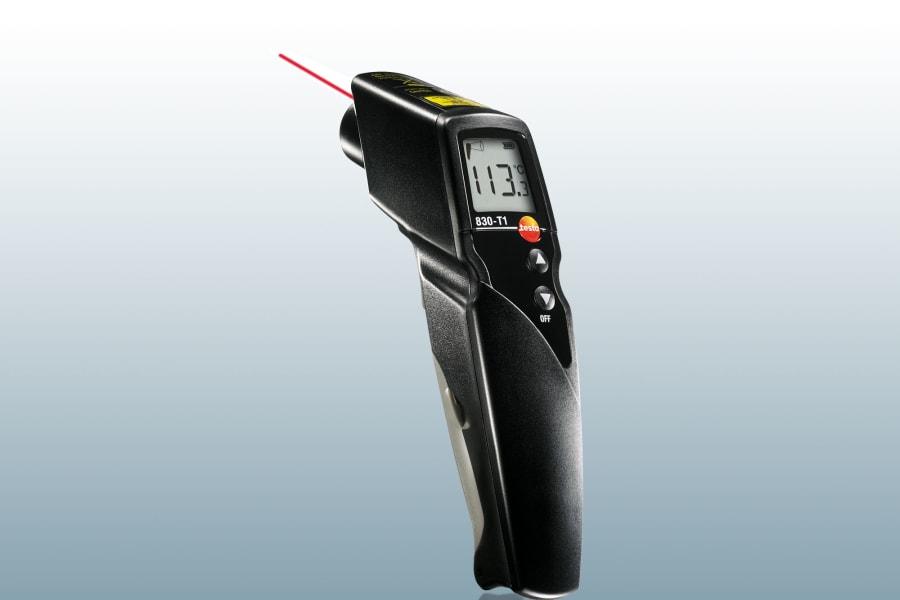
Infrared thermometer
New!
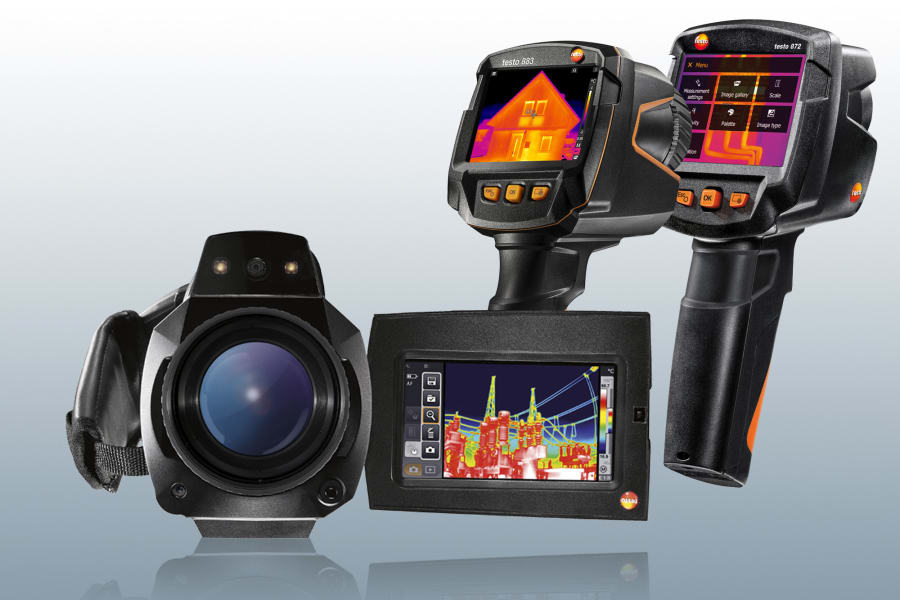
Thermal imaging cameras
Highlight
Material moisture meter