Testo official store
Free delivery
Secure payment
Testo official store

Photometer
Luminous intensity precisely tested

Optimal workplace lighting isn't just a comfort—it's a legal and practical necessity in the UK. Regular light intensity measurements using a photometer are essential for ensuring correct light distribution and intensity. This is crucial for safety and efficiency.
Why it Matters?
Safety First: Sufficient light intensity prevents errors, particularly when operating machines, reducing the risk of accidents.
Employee Well-being: Adequate lighting prevents fatigue and eye strain, boosting concentration and productivity.
Regulatory Compliance: UK standards, such as the Workplace (Health, Safety and Welfare) Regulations 1992, make proper lighting a legal requirement.
By using a photometer, you're not just measuring light; you're actively creating a safer, more productive environment for everyone.
Lighting distribution and intensity at the workplace
Optimum lighting conditions in public buildings
Light distribution measurement at trade fairs and exhibitions
Good machine illumination in production
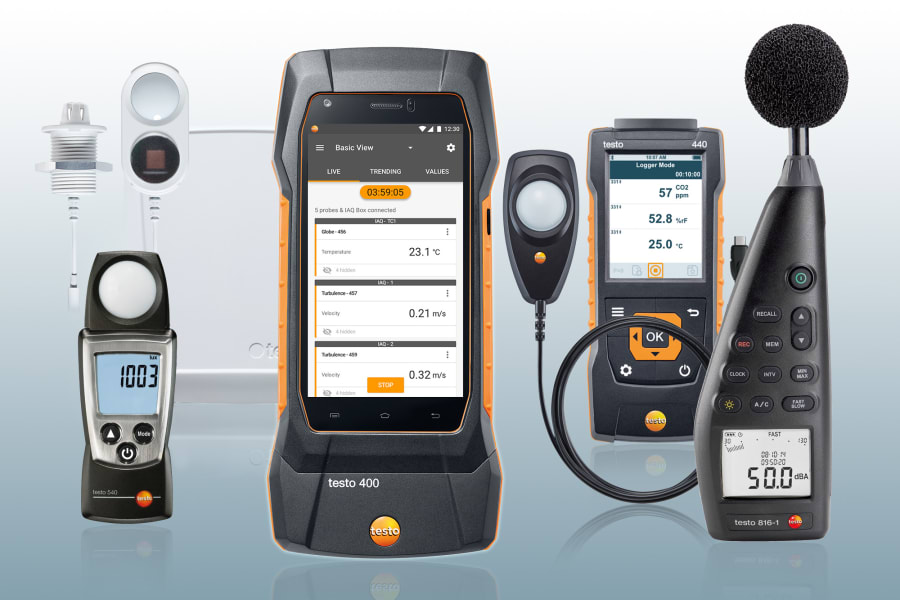
Your ideal light meter - from entry-level to professional models
You might also be interested in
Measure light intensity: Photometers for every application requirement
Can lux be measured? Photometry has the answer and knows that the photometer is the right tool for the job. One lux means that a luminous flux of one lumen hits an area of one square meter and illuminates it evenly. The photometer is therefore also known as a "luxmeter" because it measures illuminance.
Different devices are available for all applications:
Multifunctional devices for measuring light and climate parameters
Luxmeter with connectable probes
Photometer without interchangeable probes
Data logger for collecting and storing data
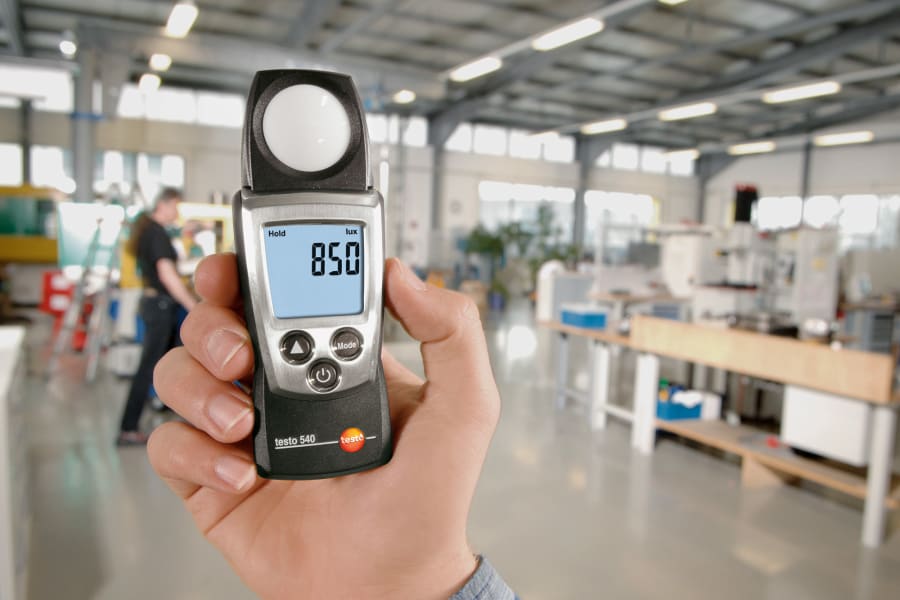
The photometers from Testo are characterized by their compact design and enable light measurement to be carried out easily and within a very short time. The sensitive and high-precision sensors are adapted to or correspond to the spectral sensitivity of the human eye. Thanks to the hold function, the measured values can be easily read off. The large display also allows readings to be taken from different angles. The photometer is used wherever the correct and sufficient distribution of light is important.
The lighting of a room or a specific area is particularly important in offices and production facilities, as well as in assembly halls and medical facilities. Testo photometers measure light intensity and distribution precisely and in a matter of seconds. Spot measurements are also possible.
The sensor plays a crucial role for the photometer. This is because its task is to perceive the light in the environment in a way that is also possible for the human eye. Accordingly, the sensor must perceive yellow and green light better than red or blue. Further criteria for photometers are:
Well-structured operating menu
Intuitive operation
Large display
Evaluation according to the V-lambda curve

Light meter: an indispensable aid for occupational safety
Occupational safety is also responsible for protecting the eyes. These are often subject to heavy strain in the workplace, which can be due to computer work in the office or different lighting conditions in the production hall. Photometers are used to ensure that legal standards and specifications are adhered to. If everything is known about the existing lighting conditions, these can be adjusted in accordance with the legal limit values. A sound level meter is often used at the workplace at the same time as the photometer, as noise levels also play a decisive role in health and efficiency at the workplace.
In addition to the sound level meter already mentioned, a speed meter can also be used. It complements the photometer and is ideal for measurements in production and air conditioning technology.
The CO measuring device also works with sensitive sensors and detects even low concentrations of the toxic carbon monoxide. If the room air is to be monitored permanently, the CO₂ measuring device from Testo is ideal, which measures the conditions in the workplace together with the photometer and thus ensures that changes are possible. Because only where poor values are known can something be done about them! If you know that the office is too dark or too poorly ventilated, you can look for solutions in terms of room technology and architecture and offer your employees better conditions. In libraries, galleries and museums, it is also important to keep an eye on all climate data, CO readings and light levels in order to protect sensitive objects.
The photometer can measure light intensities. However, if these are to be stored and made available for a longer period of time, it is advisable to record the measured data in the data logger. Not only is it possible to measure the light, but other data such as temperatures, humidity and UV radiation can also be recorded. Testo can store the data in the cloud. Photometers are also available with external probes. The required probe, which is used to monitor very light-sensitive objects in an exhibition, for example, is connected to the data logger. The measured values are processed in the probe, which is extremely precise.