Testo official store
Free delivery
Secure payment
Testo official store

- Home
- Know How
- Pressure Measurement
- Pressure measuring instruments: pressure gauges, differential pressure instruments, and vacuum measuring instruments | Testo
Select the right pressure measuring instruments for your measuring task

Which pressure measuring instrument is suitable depends on the pressure type, measuring range, medium, temperature, connections, accuracy requirements, and documentation requirements. The measuring task is decisive – not merely the instrument designation or the number of decimal places.
Which pressure measuring instrument do I need?
Before selecting an instrument, define what is to be measured: absolute pressure, gauge pressure, negative pressure, or differential pressure. For vacuum measurements, also clarify whether the instrument displays negative pressure relative to the ambient pressure or absolute pressure.
Also determine the expected normal range, possible pressure peaks, the medium, temperature, measuring point, and operating condition of the system. This makes it possible to assess which instrument category and measuring range are suitable.
Single measurement or monitoring
Pressure gauges and digital handheld instruments are suitable for spot checks. If pressure profiles, fluctuations, or limit violations need to be tracked over a period, data loggers or monitoring solutions may be used.
Considering documentation requirements
For simple checks, a direct display with manual documentation may be sufficient. For recurring or quality-critical processes, memory, timestamps, reports, digital data transmission, and an unambiguous assignment to the measuring point may be important.

Differential and absolute pressure instruments
Differential pressure instruments compare two pressure sides and therefore require correctly assigned connections. Absolute pressure instruments reference the measured value to the absolute vacuum. Gauge pressure instruments reference it to ambient pressure.
Before measuring, check the pressure type, reference, zero point, hose system, and connection assignment. If differential pressure connections are reversed, the measured value is displayed with the opposite sign. The magnitude may nevertheless appear plausible, so the measuring direction and sign must match the evaluation.
Example: filter and duct measurement
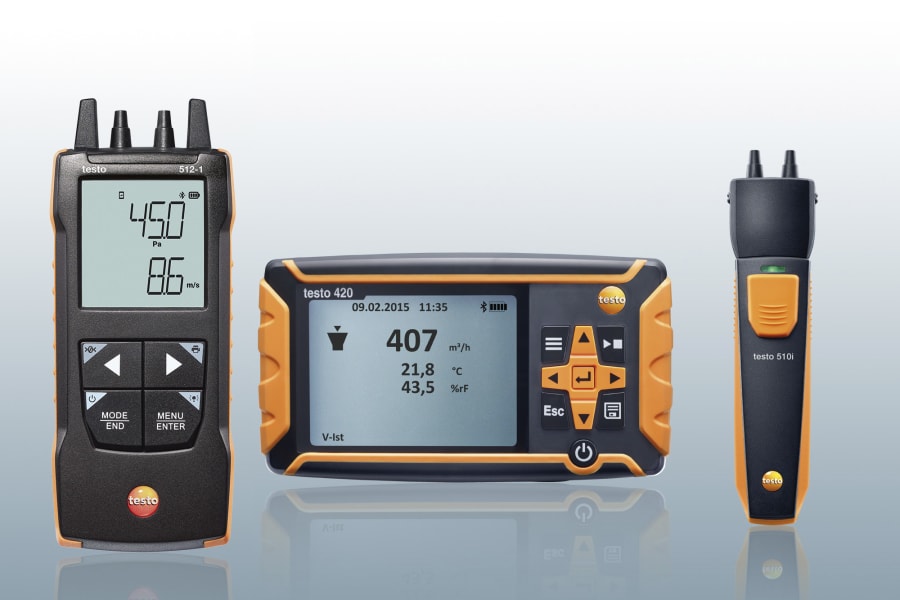
For filters and ventilation ducts, a differential pressure instrument with a suitable measuring range and sufficient resolution is required. Maintenance limits should be taken from the filter or system documentation and not derived generally from a single measured value.
In low pressure ranges, for example in ventilation and cleanroom applications, even small changes can be relevant. Therefore, take into account the measuring range, resolution, zero-point stability, hose routing, and possible pressure peaks. Also document the measuring point, measuring direction, and system condition.
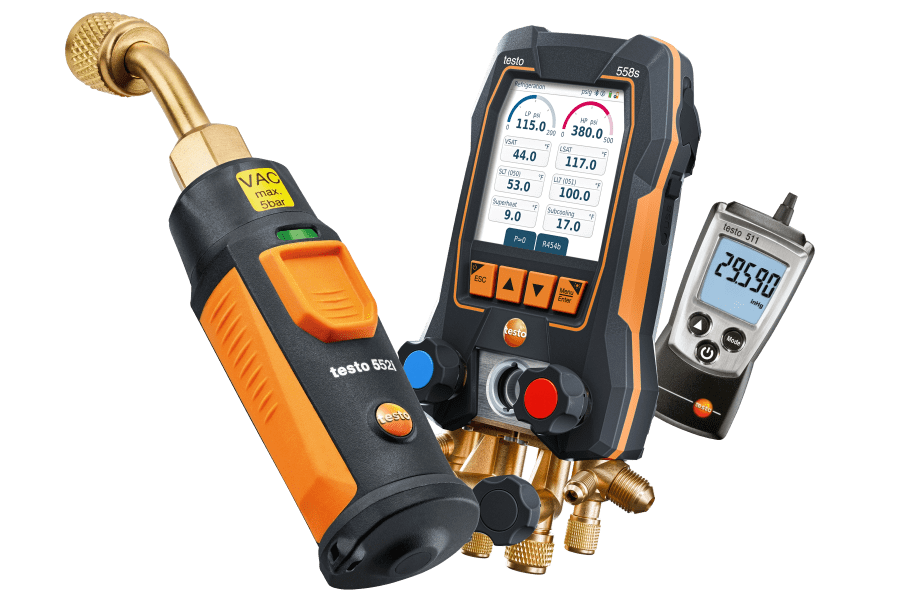
Pressure measuring instruments for refrigeration systems and heat pumps
Pressure measurement, pressure testing, leak detection, refrigerant charging, and evacuation place different requirements on instruments. Therefore, select the measuring instrument to suit the respective work step:
Measure operating pressure: Pressure gauges or digital manifolds support spot measurements and service work.
Perform a pressure test: The measuring range, connections, and permissible load must suit the test procedure and the system.
Search for leaks: A suitable leak detector is used for this purpose. Leak detection is not the same as pressure measurement.
Evacuate the system: A vacuum measuring instrument is intended for measuring low pressures.
Charge refrigerant: Depending on the workflow, a refrigerant scale can supplement pressure measurement.
Before use, check the instrument’s permissible operating limits as well as the specifications of the manufacturer and the intended procedure. The medium, temperature, connection type, and possible pressure peaks must also be taken into account.
A suitable workflow includes connecting the instrument, checking the zero point and connections, measuring, checking plausibility, and documenting the results. For recurring tests, memory and transmission functions can reduce manual effort.

Selection criteria for practical use
Pressure gauges, digital manifolds, differential and absolute pressure instruments, vacuum measuring instruments, data loggers, and monitoring solutions serve different purposes. The appropriate instrument category depends on the measuring objective, process requirements, and desired documentation.
Comparing measuring range, resolution, and accuracy
The measuring range should cover the expected operating values. A larger measuring range is not automatically better: small pressure changes may be resolved less effectively within it. Resolution also does not replace sufficient accuracy.
Also take possible pressure peaks into account. They must not exceed the permissible overload limit specified in the data sheet. Check how the accuracy specification is defined and compare the technical data with the actual normal range of the application.
Record the decision and documentation
Before ordering, record the pressure type, expected minimum and maximum values, pressure peaks, medium, temperature, connection type, calibration requirement, and desired scope of documentation. This makes it traceable why the selected instrument category suits the measuring task.
The data sheet provides technical characteristics and permissible operating conditions. The operating instructions describe connection, commissioning, and safe use. Both should be consulted for a sound selection decision.
Do you have questions or would you like personal advice? Contact us!
We look forward to supporting you with our expertise and individual solutions.