Testo official store
Free delivery
Secure payment
Testo official store

Precise measurement technology for safe food
Focus on food safety
Ensure maximum food quality and safety with Testo’s reliable, oil monitoring solutions
Challenges in quality assurance
We understand your daily requirements.
Time-consuming processes
A lack of automation leads to data loss and inefficient use of resources.
Staff shortage
Changing staff and constant time pressure are detrimental to customer satisfaction.
Inaccurate measurements
Incorrect measurement results jeopardise product quality and economic success.
Areas of application
Gastronomy & Commercial Kitchens
Restaurants, catering services, and hotels utilise professional frying oil testers to maintain peak oil quality and consistency.

Food Production & Manufacturing
Manufacturers use frying oil testers to monitor the shelf life and freshness of oils used in high-volume deep-frying lines.

Laboratory Analysis & Quality Control
Laboratory experts use these high-precision tools to verify oil integrity and ensure strict regulatory compliance.

Our product highlights
Key benefits of the testo 270 BT frying oil tester
Intuitive display illumination indicator function based on the traffic light principle
Seamless app integration for error-free and digital documentation
Simple cleaning under running water in accordance with protection class IP65
HACCP and NSF-certified for maximum food safety
How does the testo frying oil tester work?
Successfully measure frying oil – with the testo 270 BT frying oil tester
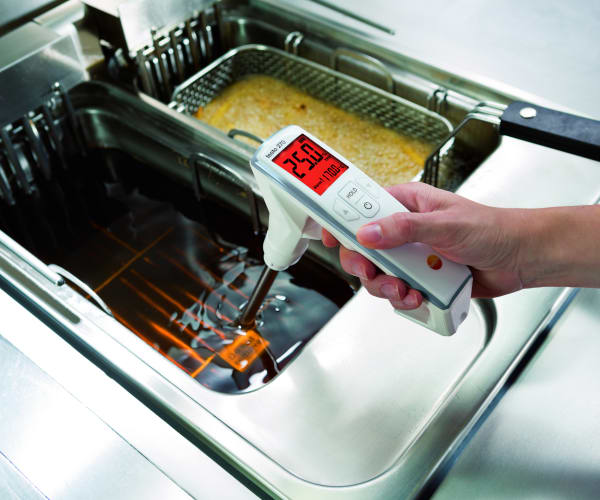
A visual check or sniff test alone cannot sufficiently confirm whether frying oil still offers good quality. With the testo 270 BT frying oil tester, restaurant operators only need to change the frying oil once critical TPM values are reached. This eliminates unnecessarily frequent frying oil changes and the associated costs, while ensuring consistently high quality. The integration with the testo Smart App makes the entire process even simpler and more error-resistant, plus ensures paperless documentation.
Once the fried food and any residues have been removed from the deep fryer and no further bubbles rise from the oil, this indicates that the oil no longer contains any water and the measurement can be performed accurately. Both water and food would impair the measurement.
The ideal position lies between the minimum and maximum markings on the probe, similarly to when checking the oil level in a car. At least 1 cm clearance should be retained between the probe and the deep fryer’s metal components. Make small circular movements in the frying oil to test it as it is no longer homogeneous after use.
If you use the testo 270 BT frying oil tester in Auto-Hold mode, the display will flash during the measurement. Once it stops flashing, the measured value has stabilized and the proportion of total polar materials (TPM) and temperature of the oil appear on the tester’s display. The measurement process is optimally supported by the app-based frying oil measurement programme but can also be easily performed manually without the app.
The display’s background illumination makes interpreting the TPM value particularly easy:
Green (less than 20% TPM): the oil quality is good.
Orange (between 20% and 24% TPM): the oil quality is still okay but it is advisable to change or filter the oil in the near future.
Red (over 24% TPM): the oil in the deep fryer needs to be changed.
Incidentally, frying oil develops its best potential between 14% and 20% TPM: in this range, the oil is safe and makes the fried food taste particularly delicious.
When using the testo 270 BT, you can define custom TPM limit values and pin-protect important instrument configurations to prevent accidental or undesired changes.
Frying oil measurement – practical advice, tips and tricks + a look at the new guidlines
Take a look now to see how you can ensure your processes are compliant and future-proof.

Information on the new guidelines
See how you can save up to 20% on cooking oil costs.
Expert tips on food measuring devices
And much more...
Legal framework incl. HACCP
Information on sprout growth
What is measured and how?
Expert tips on food measuring devices
And much more...
Frequently asked questions
Do you have any questions? We have the answers! Our FAQs provide useful responses to the most common questions about frying oil quality and our products.
To safely and precisely test the quality of frying oil, we recommend the easy-to-use testo 270 BT frying oil tester.
Remove the fried food and wait until no more bubbles can be seen in the oil.
Switch on the frying oil tester.
Immerse the frying oil tester in the hot oil and perform the measurement. The app-based frying oil measurement programme supports you during the measurement process, but the measurements can also be performed manually without the app.
Directly read the TPM value on the display. Thanks to integration with the testo Smart App, you can keep a constant eye on the TPM values of your frying oil and conveniently monitor and analyze all relevant data on your mobile device. Instant notifications and recommendations based on your TPM measurements help you optimize the oil quality. The colour-coded display illumination clearly indicates the condition of the oil: green for a healthy TPM content, orange for a critical value and red for exceeded limit values.
The shelf life of frying oil varies depending on the oil used and the frequency of frying. To ensure that the frying oil is always of optimum quality, the regular use of a frying oil tester is recommended. This enables you to quickly test the oil quality and ensure safe frying. Depending on how much the deep fryer is used, it can be useful to initially monitor the quality daily and then adapt the test intervals.
To maximize the shelf life of the frying oil, this should be filtered after every use and the deep fryer should be covered over when not in use. The oil should also be stored in a cool, dark place. Despite efforts to maximize the shelf life of the frying oil, please note that it will not last forever. If any signs of quality defects arise, the frying oil should therefore be changed for health reasons.
The amount of time for which frying oil can be used varies depending on the quality of the oil, the type of food fried and the temperature when frying. As a general rule, frying oil can be reused up to five times as long as it does not show any signs of deterioration. There are several natural signs of when it is time to change the frying oil:
Dark discolouration or loss of clarity
Rancid or unpleasant odour
Smoke formation prior to reaching the desired temperature
Unusual taste or texture of the fried food
To minimize all risks, we recommend using a frying oil tester. This useful instrument makes it possible to monitor the condition of the frying oil and therefore determine the optimum time to change it. This kind of oil tester can be extremely beneficial when it comes to constantly guaranteeing the quality of the oil.
For companies in the food industry, frying oil is often an unavoidable side product of their everyday activities. However, improperly disposing of the oil from deep fryers can have severe environmental consequences.
Oil contains saturated fats, pollutants and food residues that can negatively affect the environment if disposed of improperly. For example, if oil from deep frying gets into drains, it can cause blockages that damage both your company and the environment. Improper disposal methods can also cause soil and water pollution and pose risks to local animals and plant life.
There are various safe and environmentally conscious ways of disposing of oil from deep frying.
Professional disposal services: companies that have specialized in the disposal of frying oil can be found in many regions. These providers are familiar with local regulations and recycle oil in an environmentally friendly manner. It is worth researching such services carefully and choosing ones that demonstrably use environmentally friendly methods.
Cooperation with biodiesel producers: some companies, such as producers of biodiesel, may be interested in used frying oil. These recycle the oil to produce biodiesel, which can be used as a sustainable alternative to conventional fuel. Cooperation with such companies can be an ecologically sound solution for both your company and the environment.
Waste separation and disposal: to make it easier to dispose of frying oil, companies can equip their premises with suitable collection containers. These should be securely and tightly sealed to prevent leaks. The collected oil can then be picked up by authorized disposal services and duly recycled.
Contact us
Do you have any questions or requests? We’re happy to help – please enter your contact details and your request below.

testo Smart App
One App for all applications
In addition to the usual precise measurements, discover effortless, reliable and HACCP-compliant digital documentation in future.