
Emission measuring instruments:
Measuring, monitoring and documenting emissions safely

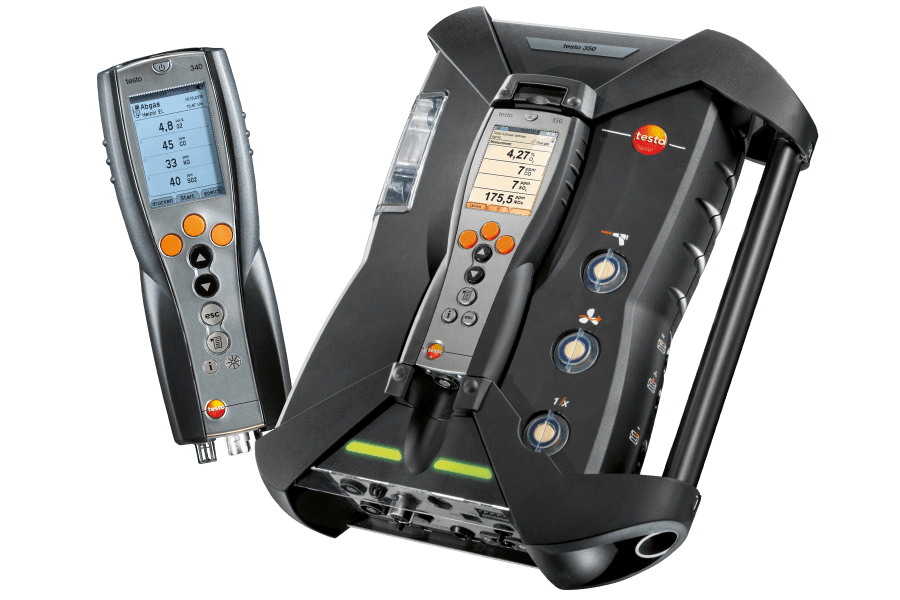
Classification & overview
Emission measuring instruments record concentrations of relevant flue gas components such as O2 in vol. %, CO, CO2, NOx or SO2 in mg/m3, as well as dust levels in the flue gas stream. This helps ensure compliance with statutory emission limits, enables efficient plant operation, and allows measurement results to be documented in an audit-proof manner. They link technical processes with environmental and emissions-protection requirements and are therefore a key component of modern flue-gas measurement concepts.
Emission measuring instruments are used wherever combustion or process steps release exhaust gases into the environment—typically at chimneys, exhaust ducts or defined measuring points along the flue-gas path. They provide reliable readings for components such as O2, CO, CO2, NOx, SO2 or total dust and enable operators to demonstrate compliance with limits from regulations such as Germany’s 13th and 17th BImSchV or relevant EU directives on emission reduction.
This raises a few key questions for users: which substances are actually considered emissions? Which measured variables are relevant for my specific plant? Where do measuring points need to be set up, and how are they implemented correctly from a metrological perspective? This topic world answers these questions step by step—from basic classification and typical use cases through to measurement principles and instrument categories.
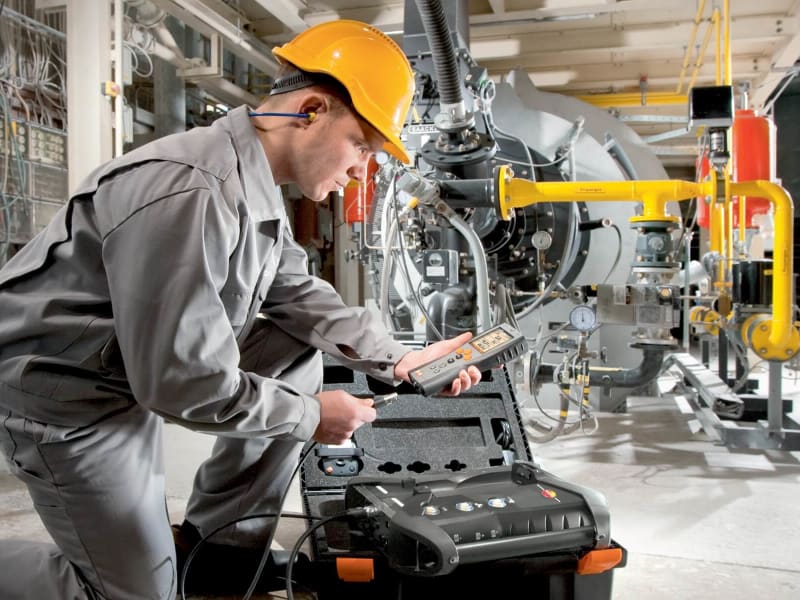
A practical example: in a natural-gas-fired boiler, O2 and CO concentrations are continuously monitored to ensure both efficiency and compliance with permissible CO emission values. Even small deviations in the O2 content (e.g., from 3 to 6 vol. % at the boiler) can noticeably increase fuel consumption and worsen the emissions balance. Emission measuring instruments provide the data needed to coordinate excess-air ratio, fuel supply and downstream flue-gas treatment equipment.
Fundamentals of emission measurement
Before selecting specific measuring instruments or designing measurement concepts, a shared understanding of the technical fundamentals is essential. These include the difference between emissions (release of substances into the environment) and immissions (pollution at a specific location), typical measured variables in flue gas measurement, and the temporal progression of measurement tasks throughout the entire plant lifecycle – from commissioning through recurring inspections to continuous monitoring.
The key measured variables include, for example:
Oxygen (O2) in vol.% as a reference variable for setting the combustion process,
Carbon monoxide (CO) and carbon dioxide (CO2) in mg/m³ or vol.%,
Nitrogen oxides (NO, NO2, collectively referred to as NOx) and sulphur dioxide (SO2) in mg/m3,
Dust and particle concentrations in mg/m3
 AI-generated
Application areas & industries
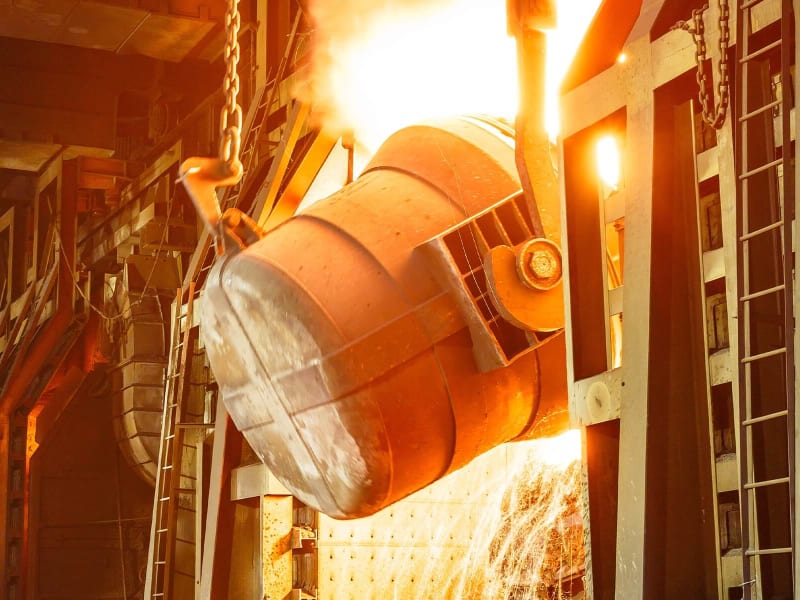
Emission measuring instruments are used in a wide range of industrial applications. These include, among others, boiler and combustion systems in energy generation, glass and cement kilns, processes in the metal and steel industry, plants in the aluminium and mining industry, as well as combined heat and power (CHP) units and other cogeneration systems. Flue gas composition, temperature ranges, dust content and humidity vary considerably depending on the industry and each require adapted measurement concepts.
In boiler systems, the focus is often on continuous monitoring of O2, CO and NOx to ensure both energy efficiency and compliance with limit values. In the cement or glass industry, high process temperatures, abrasive dusts and long measurement paths are typical challenges for measurement probes and gas conditioning. In CHP applications, practical measurement concepts play a role that enable both campaign measurements and recurring inspections at various units.
Technologies in emission measuring instruments
Behind every emission measurement value lie physical measurement principles and a suitable device configuration. The typical technologies in emission measuring instruments include:
NDIR measurement cells (non-dispersive infrared measurement) for gases such as CO, CO2 or NO,
electrochemical sensors for O2, NO2, SO2 and other components,
paramagnetic sensors for precise O2 measurements,
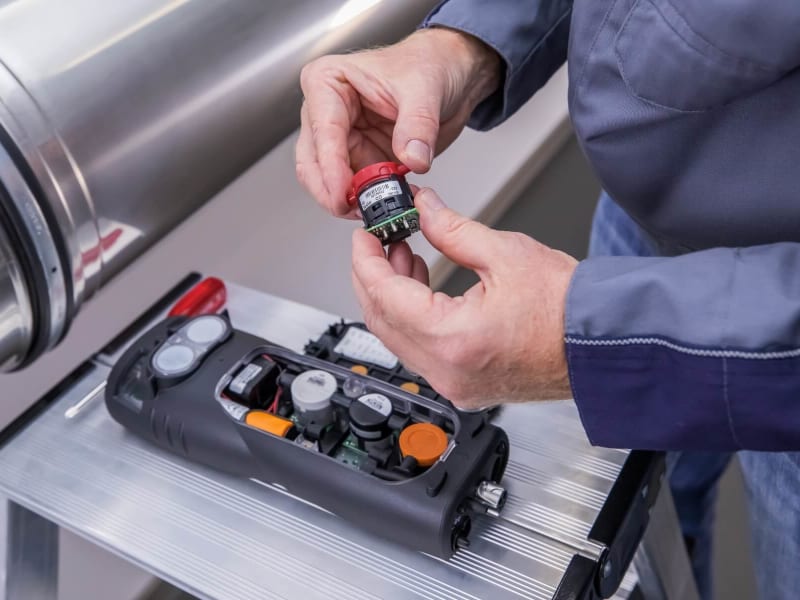
sampling and gas conditioning systems with heated extraction probes, heated hose lines and conditioning modules.
The choice of the appropriate technology depends on several factors: which components need to be detected, in which concentration ranges and under what boundary conditions (flue gas temperature, dust content, humidity)? Should measurements be taken at specific points – for example as part of service measurements – or continuously for permanent measurement? And what requirements exist for measurement uncertainty, detection limits and response times?
Measuring instruments & product overview
Which emission measuring instrument is suitable for a specific task depends on the type of measurement, the required measurement components and the required degree of automation. In principle, three categories can be distinguished:
mobile emission measuring instruments for service, commissioning and campaign measurements,
stationary emission measurement systems for continuous monitoring tasks,
probes, sampling systems, gas conditioning modules and accessories as supplements.
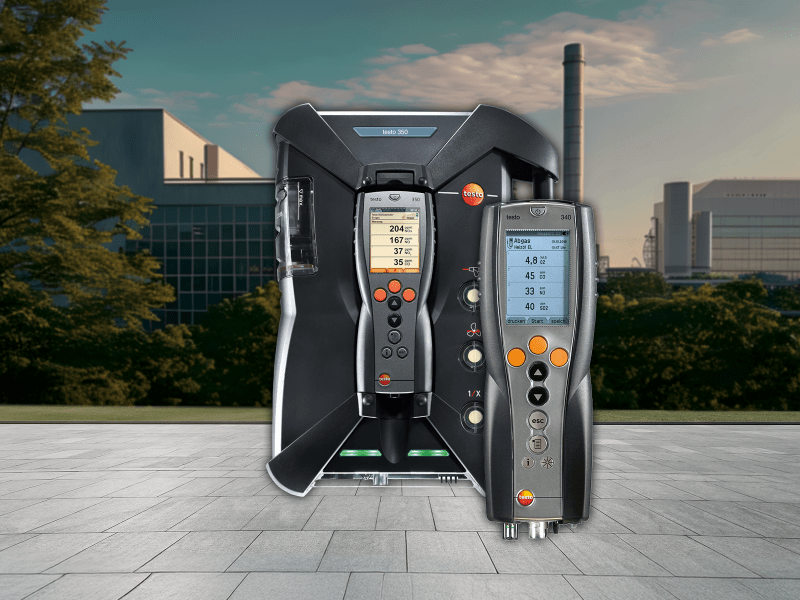
Mobile emission measuring instruments are typically used for recurring inspections of boiler and combustion systems, for burner adjustment or for measurement campaigns at changing plants. They must be robust, ready for use quickly and easy to operate, while at the same time delivering measurement values that can be documented traceably and prepared in reports.
Stationary emission measurement systems are used where limit values must be permanently monitored and measurement results must be recorded over long periods – for example at large combustion plants or in energy-intensive industries. Here, topics such as automatic zero and span checks, long-term stability and standard-compliant data archiving play a central role.
Practical knowledge, references & downloads
Practical reports, reference projects and technical documents help to better evaluate emission measurement concepts and support investment decisions. In this section of the topic world, selected references and downloads are bundled. They show how emission measuring instruments are used in real projects, what challenges typically arise in practice and which solution approaches have proven themselves.
Examples include white papers on emission measurement at combined heat and power plants, application descriptions for specific measurement tasks, and reports from industrial and energy generation projects. Users thus receive both technical background information and field experience – an important element for strengthening experience and trust signals and substantiating decisions on a technical basis.

Do you have questions or would you like personal advice? Contact us!
We look forward to supporting you with our expertise and individual solutions.