
- Home
- Know How
- Temperature Meaurement
- Basics
- Avoiding measurement errors in temperature measurement
Avoiding measurement errors – tips for correct measurement

The most common measurement errors
If the temperature probe is colder than the object being measured, energy in the form of heat is extracted from the object in the area around the probe. If it is warmer than the object being measured, heat is transferred to the object.
The mass ratio of the probe to the medium must also be taken into account: the greater this ratio, the more energy is extracted from the object being measured. Since this energy extraction means that the actual temperature of the object is no longer being measured, an excessively high probe mass can lead to measurement errors.
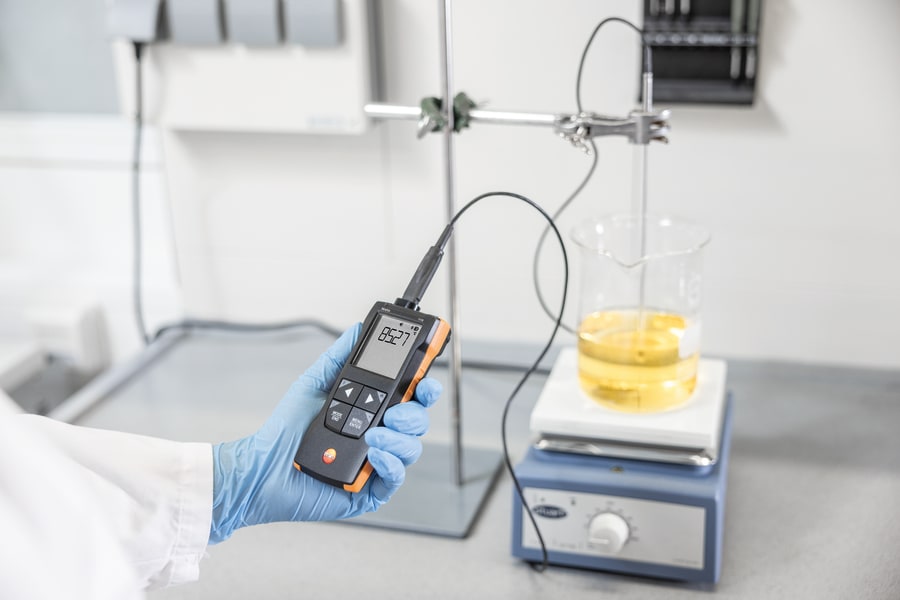
Penetration and immersion measurement
For penetration or immersion measurements, the temperature probe is inserted directly into the object being measured. The measurement is complete once the t99 time has been reached.
Tips for correct penetration measurement
The immersion depth or penetration depth should be 10 to 15 times the probe diameter.
For immersion measurements in liquids, the liquid should be kept in constant motion.
Ideally, t99 is reached after approx. 0.5 seconds.
Surface measurement
For surface measurements, the probe head is placed perpendicularly on the surface. Care must be taken to ensure that neither the contact surface of the probe head nor the object being measured is uneven, as this can distort the measurement.
Tips for measuring surface temperature
Place the probe tip flat against the surface.
Do not move the probe during measurement.
Apply a constant and sufficient contact force.
Use low-mass surface probes.
Ideally, t99 is reached after approx. 3 seconds.

Measurement of air temperature
When measuring moving air, the sensor is simply placed in the environment to be measured. To achieve a short response time, ideally use an air probe with an exposed sensor. The measurement result can be optimised by moving the probe through the air at 2 m/s during measurement.
Tips for measuring air temperature
Use an air probe with an exposed sensor (not a penetration or surface probe).
Move the probe at 2 m/s during measurement.
Keep the probe outside your own breathing zone.
Use a radiation-shielded probe.
Ideally, t99 is reached after approx. 7 seconds.

Do you have questions or would you like personal advice? Contact us!
We look forward to supporting you with our expertise and individual solutions.