
- Home
- Know How
- Emission Measuring Instrument
- Emission measuring instruments – basics of emission measurement | Testo
Basics of emission measurement with emission measuring instruments
 AI-generated
Emission measuring instruments measure the concentration of exhaust gas components such as O2 in vol.-%, CO, CO2, NOx or SO2 in mg/m³ as well as dust contents in the exhaust gas stream, so that operators can demonstrate compliance with statutory emission limit values and operate their plants efficiently and in an environmentally friendly manner. They form the technical basis for reproducibly recording, documenting and demonstrating emissions to authorities and inspection bodies.
What is an emission measuring instrument?
An emission measuring instrument is a measuring system that detects, evaluates and provides gaseous or particulate pollutants in exhaust gas in standardised units. It typically consists of:
a sampling device (e.g. heated probe in the exhaust gas stream),
a gas conditioning unit (e.g. conditioning, drying, dust separation),
an analyser with suitable sensors or measuring paths,
an evaluation unit for displaying, storing and documenting the measured values.
Emission measuring instruments are used wherever combustion processes or industrial processes release exhaust gases – for example in boiler and combustion systems, in the cement, glass or metal industry, and in combined heat and power plants. They provide measured quantities such as O2, CO, CO2, NOx, SO2 or total dust in defined units (e.g. mg/m3 at standard conditions), thereby creating the basis for a reliable assessment of the emission situation.
In practice, users frequently ask what an emission measuring instrument is actually needed for. The answer is simple: without reliable measured values, limit values from regulations such as the 13th or 17th BImSchV, EU industrial emissions directives or sector-specific requirements cannot be demonstrated. Emission measuring instruments close this gap between legal requirements and the actual operation of a plant.

Emissions, immissions and measured quantities
For a clear understanding of emission measurement, the distinction between emissions and immissions is central. Emissions describe the substances released from a source – such as a chimney or an exhaust pipe. Immissions refer to the resulting pollution at a specific location, such as a measuring point in the vicinity of the plant. Emission measuring instruments generally focus on the emissions at the exhaust gas outlet.
Typical measured quantities in exhaust gas measurement are:
Oxygen (O2) in vol.-% as a reference quantity for assessing combustion,
Carbon monoxide (CO) and carbon dioxide (CO2) in mg/m3 or vol.-%,
Nitrogen oxides (NO, NO2, summarised as NOx) in mg/m3,
Sulphur dioxide (SO2) in mg/m3,
Total dust or fine dust in mg/m3.
Typical measured quantities in exhaust gas measurement
O2 frequently serves as a reference quantity to convert emission values to a defined oxygen content and to make different operating states comparable. CO is regarded as an indicator of incomplete combustion, while CO2 allows conclusions to be drawn about fuel conversion. NOx and SO2 are the focus of many emission regulations, as they contribute significantly to acidification, smog formation and health impacts. Dust and particle measurements are particularly relevant in dust-intensive industries such as cement, metal or glass.
Practical example: in a gas-fired boiler, the O2 content in the exhaust gas is typically set to a range of approximately 3–5 vol.-%, in order to achieve a compromise between complete combustion and minimal exhaust gas losses. If the O2 content rises significantly, this frequently indicates excessive excess air and thus efficiency losses.
Units, reference conditions and standard specifications
Measured values from emission measuring instruments are only comparable if units and reference conditions are clearly defined. In emission measurement technology, gas concentrations are often expressed in mg/m3, referenced to:
a defined standard state (e.g. 0 °C, 1013 hPa),
dry or wet exhaust gas conditions,
a reference oxygen content (e.g. 3, 6, 11 or 15 vol.-% O2, depending on the plant type).
Standards and guidelines specify how these reference conditions are to be applied. In Germany and the EU, for example, the Industrial Emissions Directive and national implementations such as the 13th and 17th BImSchV define requirements for measurement methods, reference states and emission limit values for different plant types. Emission measuring instruments must be designed so that they can map these specifications metrologically – for example through automatic reference oxygen corrections or the calculation of dry gas values.
For users, this means: when comparing measured values, it must always be checked which state and which O2 reference the stated mg/m3 values refer to. Only in this way can measurement results be correctly compared with limit values and other plants.

Measurement tasks along the plant lifecycle
Emission measurements accompany the complete lifecycle of a plant – from planning and commissioning through regular operation to modifications or decommissioning. Depending on the phase, the objectives and measurement concept differ considerably.
From commissioning to monitoring in continuous operation
During the commissioning phase, the focus is on setting up the combustion process. Mobile emission measuring instruments are used to optimise burner parameters, check O2, CO and NOx values and bring the boiler or furnace into a stable, efficient operating state. Spot or campaign measurements are frequently carried out during this phase.
During regular operation, the focus shifts to recurring or continuous measurements. Depending on legal requirements and plant size, either regularly deployed mobile devices or stationary emission monitoring systems (Continuous Emission Monitoring Systems, CEMS) are used. These record measured values at minute or second intervals, form half-hourly or daily averages and document limit value exceedances in an audit-proof manner.
Before modifications or fuel changes, emission measurements are used to assess the effects on emission behaviour and compliance with limit values. Well-documented emission measurements also play a central role in audits or inspections by authorities.
Role of emission measuring instruments in environmental protection
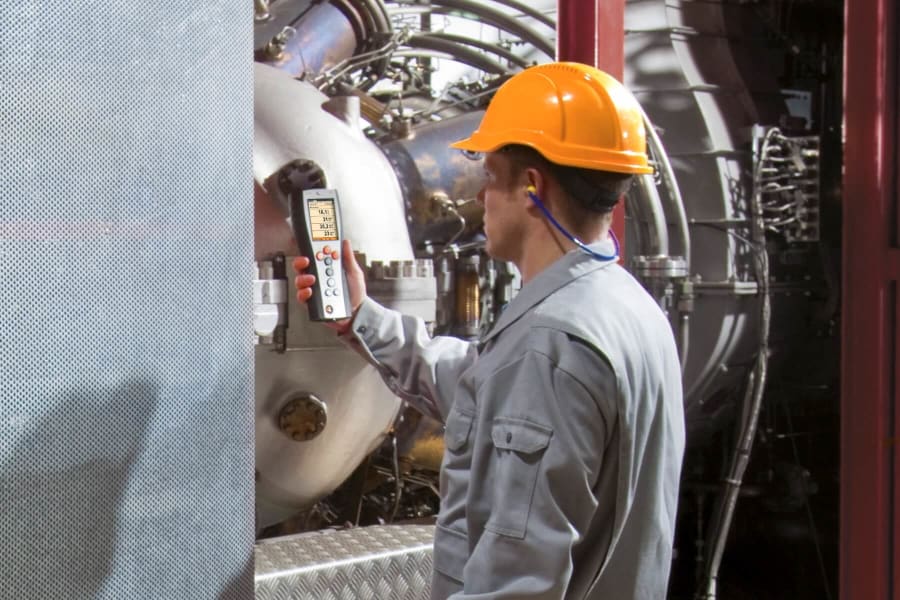
Emission measuring instruments are a central tool for translating climate and immission protection goals into concrete operational measures. They make it possible not merely to estimate emissions roughly, but to substantiate them with reliable figures and to plan measures on this basis – from optimising combustion and exhaust gas purification to switching to lower-emission fuels.
From the operators' perspective, emission measuring instruments help to:
reliably comply with limit values and avoid fines or conditions,
optimise fuel consumption and thereby reduce costs,
create transparency vis-à-vis authorities and stakeholders.
From a regulatory perspective, reliable measurement data are a prerequisite for verifying the effectiveness of emission limits and building future requirements on real-world experience. The combination of standardised measurement methods, suitable measuring instruments and clear documentation requirements ensures that emission data remain reliable over long periods of time.

Do you have questions or would you like personal advice? Contact us!
We look forward to supporting you with our expertise and individual solutions.