Directly from the manufacturer
Free shipping
Fast delivery
Secure payment
Directly from the manufacturer

The Hidden Monitoring Gaps in Your Facility:
Where Temperature Excursions Actually Happen

Why Temperature Excursions Keep Happening Despite Established Monitoring Programs
You've invested in environmental monitoring. Your sensors are calibrated. Your alarms are configured. On paper, your facility is covered.
So why do temperature excursions still happen?
For many pharmaceutical manufacturers and distributors, the honest answer is uncomfortable: the coverage isn't as complete as the monitoring plan suggests. The sensors are measuring — they're just not always measuring in the right places.
Temperature excursions don't occur randomly. They tend to concentrate at specific, predictable points throughout a facility, and those points follow the path that product takes, from the moment it's manufactured to the moment it ships. Understanding where the gaps are, and why they form, is the first step toward closing them.
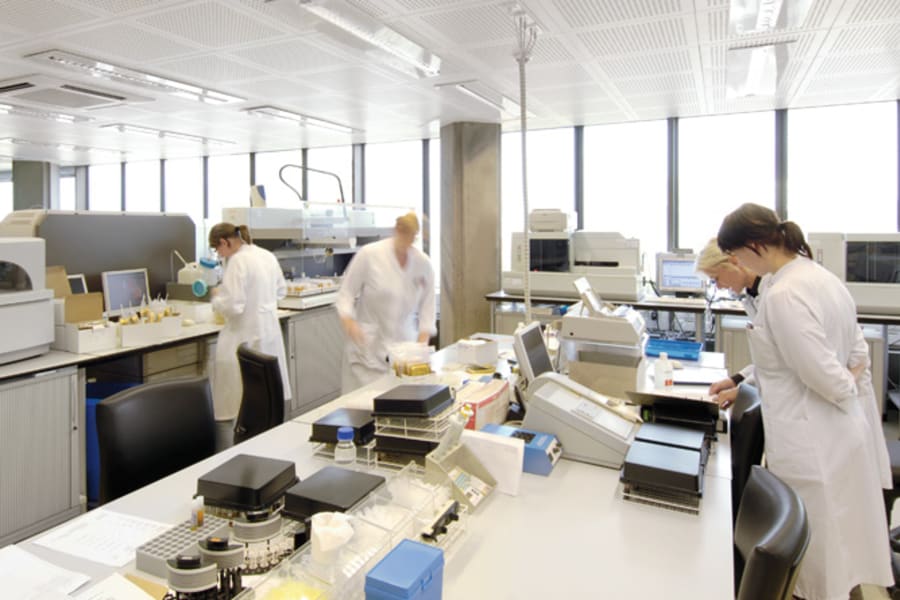
Pharmaceutical Production Equipment: Sterilization and Autoclave Monitoring Gaps
Monitoring gaps in pharmaceutical manufacturing are often less visible than those in storage, because the focus during production tends to be on process validation rather than ongoing environmental control. But the two are closely related, and the gap between them is where excursions can hide.
Autoclaves and sterilization equipment are a common example. The sterilization cycle itself is validated, but what's being validated is the cycle profile at specific sensor positions — usually fixed probe locations chosen during initial qualification. If product loading patterns change, if a new product geometry is introduced, or if a probe shifts position over time, the validated cycle data may no longer reflect actual conditions throughout the full load. Temperature distribution inside an autoclave chamber is not uniform, and the hottest and coldest zones can vary depending on load configuration and steam penetration.
More broadly, production environments create thermal challenges that ambient monitoring doesn't always capture. Heat-generating equipment, process air systems, and the constant movement of personnel all create localized conditions that differ from the room average, and where sensors are positioned relative to that activity determines whether the monitoring plan is telling the whole story.
Thermal mapping during initial qualification should account for variable load configurations, not just a single reference arrangement. For ongoing cycle validation, multi-point loggers with probes designed to withstand the extreme temperatures and pressures inside sterilization chambers, and positioned to reflect actual product exposure, provide the data needed to identify distribution issues before they become compliance events. When production environments change, requalification should follow.
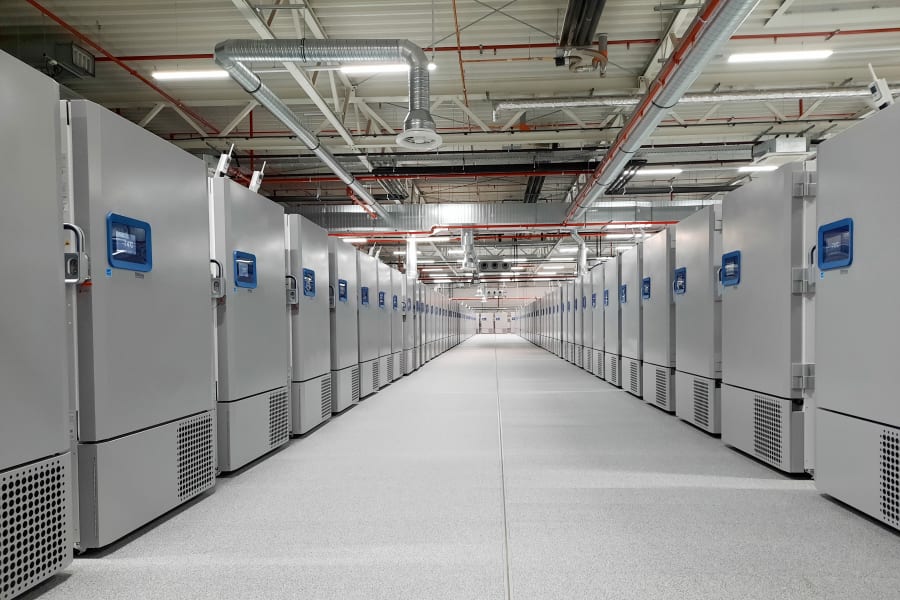
Cold Room, Freezer, and Repository Monitoring: Finding the Dead Zones in Controlled Storage
Controlled storage areas, including refrigerated rooms, cold rooms, stability chambers, and ULT freezers, are typically the most thoroughly monitored environments in a pharmaceutical facility. Yet they remain a common site for excursions, because monitoring plans are often designed around ideal conditions rather than operational ones.
Corners and dead zones are the most frequently under monitored locations in any controlled room. Air circulation is rarely uniform, and low-traffic corners, particularly at floor level and away from supply vents, tend to accumulate stagnant air that heats or cools differently from the rest of the space.
HVAC supply and return points present a related problem. Sensors placed near supply vents may read conditioned air before it has fully mixed with the room environment, while return air zones capture air already influenced by equipment heat and personnel activity. Neither reflects actual storage conditions, but both can look perfectly compliant on paper.
Repositories and ULT storage introduce a different category of risk. In chest freezers, ULT units, and biorepository systems, the thermal environment inside the equipment varies significantly based on sensor position relative to the compressor, the door seal, and product stacking configuration. A sensor at the top of a unit can read a very different temperature than product stored at the bottom during a recovery cycle, and that difference is precisely where sample integrity is at stake.
Comprehensive thermal mapping, conducted under both summer and winter conditions with sufficient sensor density to capture spatial variation, is the foundation of a defensible monitoring strategy. For repositories and cold storage equipment specifically, sensor placement inside the unit matters as much as ambient room monitoring. Facilities that already have building management infrastructure in place but lack GMP-compliant documentation should consider whether their current systems can actually serve as audit evidence, or whether a validated environmental monitoring layer is needed to close that compliance gap. Where a sensor is placed also determines how it ages; sensors in high-stress locations face greater calibration demands than those in stable interior zones, potentially leading to sensor drift that compromises data integrity over time. Placement decisions and calibration schedules should be developed together.
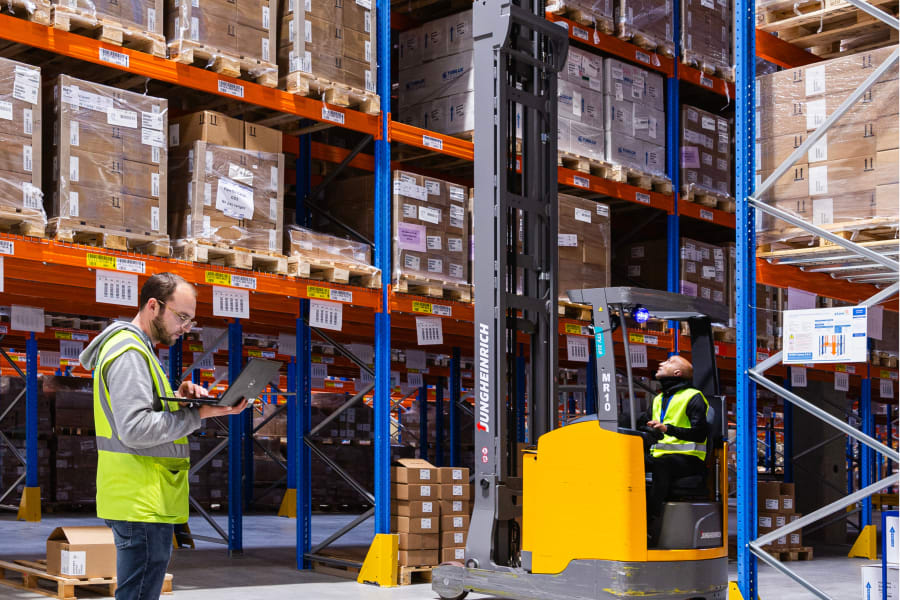
Ambient Warehouses: Managing Thermal Stability in Large-Scale Spaces
Monitoring a warehouse presents a different set of challenges than a footprint-limited cold room. Because of the sheer volume of air and the height of racking systems, these environments are highly susceptible to vertical temperature stratification where heat naturally rises and pools near the ceiling while cooler air settles at the floor.
In an ambient warehouse, environmental control is often at the mercy of the building’s shell. Internal temperatures are heavily influenced by roof solar loading during summer months and floor-level drafts during winter. Without sensors placed at varying heights (top, middle, and bottom of racking), a single wall-mounted sensor may report a safe ambient temperature while the product on the top pallet risks exceeding its labeled storage temperature.
Warehouse temperature mapping must be three-dimensional. Comprehensive thermal mapping should be conducted at multiple sensor heights during seasonal extremes (summer and winter) to identify how external weather impacts internal gradients. Wireless data loggers capable of covering large distances can help ensure consistent data collection across the full facility footprint, including the corners and aisles furthest from HVAC distribution points, providing better environmental monitoring coverage.

Loading Dock and Receiving Area Temperature Control: The Perimeter Risk Most Facilities Underestimate
The outermost zones of a pharmaceutical facility are where the internal controlled environment meets the outside world, and where monitoring coverage is most often thinner than the level of thermal risk warrants.
Receiving areas sit at the edge of the formal storage environment and are easy to overlook in a monitoring plan. Product arriving from a distribution network may have already experienced thermal stress in transit, and then sits, sometimes for extended periods, in a staging area while intake processing occurs. If that staging area is unmonitored, or captured only as part of the adjacent storage room rather than as its own zone, the conditions product is actually exposed to during intake are invisible to the record.
Loading docks are among the highest-risk locations in any facility. Open dock doors, seasonal temperature extremes, and inconsistent HVAC coverage combine to create an environment that fluctuates significantly throughout the day. Products staged near dock doors, even temporarily, can be exposed to conditions well outside their specified range, and without dedicated monitoring at dock level, those events go entirely undetected. By the time product moves into a formally monitored storage zone, any excursion that occurred during staging is already part of its history, whether the data reflects it or not.
Internal transition points present a version of the same problem within the facility itself. Every time a door opens between a temperature-controlled space and an adjacent corridor, conditioned air exits and ambient air enters. Products staged near interior doorways during picking or staging operations may be exposed to fluctuations that a centrally located sensor will never detect.
Staging and receiving areas should be treated as distinct monitoring zones, not assumed to be covered by adjacent storage sensors. A risk assessment of dock operations, including door-open frequency, dwell time, and seasonal variability, can help determine appropriate sensor placement and alarm thresholds for these high-exposure zones. For transition points within the facility, reviewing product routing and temporary staging patterns against the existing monitoring map is a practical first step toward identifying where coverage ends and exposure begins.
Building a Risk-Based Pharmaceutical Environmental Monitoring Strategy
Across all of these environments, the underlying regulatory requirement is the same: monitoring points should reflect where product is actually stored and where risk is greatest. FDA guidance, USP Chapter <1079>, and WHO Technical Report Series guidance on Good Storage and Distribution Practices all establish risk-based sensor placement as the foundation of a defensible monitoring strategy.
The Myth of Validated Equipment
A significant monitoring gap often stems from a misplaced reliance on manufacturer-level validation. While many manufacturers provide equipment that is validated and mapped according to high uniformity standards, that data is generated within the manufacturer’s highly controlled test environment.
The missing piece for many end users is that equipment will perform differently once installed in its specific operational setting. A chamber that meets spec in a test lab may behave unpredictably when placed in a high-traffic or hot lab, a cold-chain staging area, or a high-density biorepository where airflow is restricted. Without mapping the equipment within its final, real-world environment, manufacturer-validated equipment can provide a false sense of security that fails to account for site-specific thermal stressors.
These site-specific realities are precisely what regulators expect to see addressed in a facility's monitoring documentation.
That foundation matters most when something goes wrong. When regulators review an excursion event, they will be asking:
Was the monitoring plan designed to detect this type of excursion in the first place?
Do sensor positions reflect where product is actually stored and where risk is greatest?
Has thermal mapping been performed under representative conditions, including seasonal variation?
Has the monitoring strategy been updated when the facility, its equipment, or its operations changed?
A gap in any one of these areas is a gap in the evidence, and those gaps have a way of surfacing at the worst possible moment.
A monitoring strategy built around the full path of the product, from sterilization and production through controlled storage and out through the loading dock, is one that reflects how risk actually moves through a pharmaceutical facility. The goal of thermal mapping is not to confirm that the center of the room is in spec. It is to find the locations where conditions are hardest to control and most likely to diverge from expectations, and to put measurement there.
That is what it means to measure where it matters.
Next Steps
Identify and close the monitoring gaps in your facility with Testo's pharmaceutical environmental monitoring solutions, purpose-built for compliance from production to distribution.
