Directly from the manufacturer
Free shipping
Fast delivery
Secure payment
Directly from the manufacturer

- Home
- Testo Bioanalytics
- Resources
- Article: Listeria monocytogenes detection on food contact
Articles
Listeria monocytogenes detection on food contact
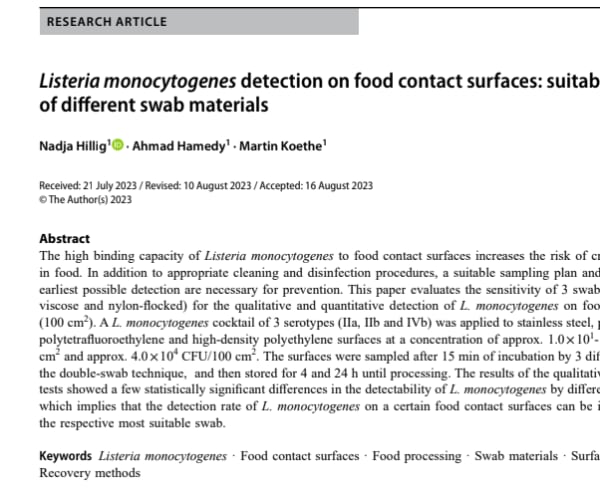
The high binding capacity of Listeria monocytogenes to food contact surfaces increases the risk of cross-contamination in food. In addition to appropriate cleaning and disinfection procedures, a suitable sampling plan and technique for the earliest possible detection are necessary for prevention.
This paper evaluates the sensitivity of 3 swab materials (cotton, viscose and nylon-flocked) for the qualitative and quantitative detection of L. monocytogenes on food contact surfaces (100 cm2).
A L. monocytogenes cocktail of 3 serotypes (IIa, IIb and IVb) was applied to stainless steel, polyvinyl chloride, polytetrafluoroethylene and high-density polyethylene surfaces at a concentration of approx. 1.0 × 101-1.0 × 10² CFU/100 cm2 and approx. 4.0 × 10⁴ CFU/100 cm2.
The surfaces were sampled after 15 min of incubation by 3 different swabs using the double-swab technique, and then stored for 4 and 24 h until processing.
The results of the qualitative and quantitative tests showed a few statistically significant differences in the detectability of L. monocytogenes by different swab materials, which implies that the detection rate of L. monocytogenes on a certain food contact surfaces can be increased by using the respective most suitable swab.