Directly from the manufacturer
Free shipping
Fast delivery
Secure payment
Directly from the manufacturer

ISO 17025, ISO 9001, or NIST?
Choosing the Right Calibration Standard for Your Facility
In the pharmaceutical and life science industries, close enough isn't a measurement; it’s a liability.
When you send your data loggers or handheld instruments in for service, you are often faced with a choice of calibration standards: ISO 17025, ISO 9001, or NIST-traceable.
While these terms are often used interchangeably in casual conversation, they represent very different levels of oversight. Understanding these differences is the key to maintaining GxP compliance and ensuring your data stands up to audit scrutiny.

Choosing the Right Calibration Standard for Your Facility
The National Institute of Standards and Technology (NIST) is the source of truth for measurements in the United States.
NIST Traceability means that the equipment used to calibrate your instrument has been compared against a higher-level standard, which was compared against an even higher one, forming an unbroken chain all the way back to NIST’s primary standards maintained by the National Institute of Standards and Technology.
Best for: General monitoring, HVAC/R applications, and facilities that require proof of accuracy but do not operate under strict international laboratory accreditation requirements.
ISO 9001 is a global benchmark for a company’s Quality Management System (QMS). It focuses on how a business operates—from customer service and leadership to how they handle non-conforming products.
At Testo, our global quality awareness is certified through ISO 9001:2015. However, ISO 9001 is not a technical calibration standard. It demonstrates that a company operates under a structured and continually improving quality system, but it does not validate the technical competence of a calibration laboratory or quantify measurement uncertainty.
Typical ISO/IEC 17025-Accredited Parameters Include:*
Temperature
Humidity
Air Velocity
Airflow
Pressure
Electrical measurements
Gas measurements
*(Additional parameters can be calibrated under ISO17025 via TIS in Germany and partner labs)
Best for: Ensuring you are doing business with a reliable, well-managed manufacturer.
While ISO 9001 looks at the whole business, ISO/IEC 17025 looks specifically at the laboratory. It is an accreditation rather than a certification. To earn it, a lab must prove not only that it has a quality system, but that its technicians are technically competent and that their measurement methods are scientifically sound.
An ISO 17025 accredited calibration includes a reported Measurement Uncertainty. This tells you exactly how much doubt exists in a measurement, which is a critical requirement for high-stakes GxP environments and audited pharmaceutical labs.
Typical ISO 9001 Traceable Parameters Include:
Light
Tachometer (RPM)
Sound
Best for: Critical pharma applications, cleanrooms, and any facility where defensible, audit-ready documentation is the top priority.
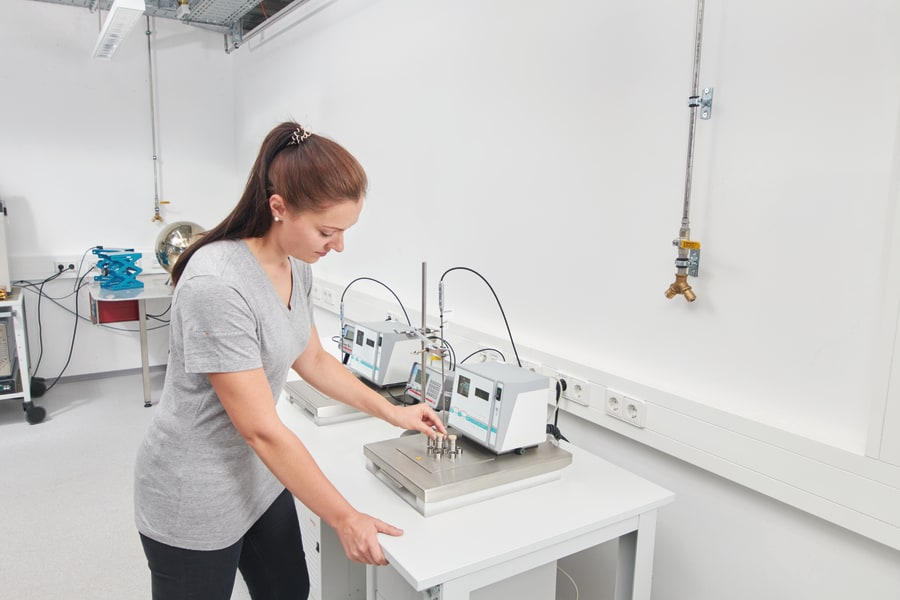
Which One Does Your Facility Need?
Choosing the right level of calibration depends on your specific SOPs and the level of risk associated with your measurements:
Need to meet general quality goals? A NIST-traceable calibration from an ISO 9001-certified manufacturer provides excellent reliability.
Operating in a highly regulated GxP environment? You likely require ISO/IEC 17025-accredited calibration to satisfy FDA or internal quality auditors.

The Testo Advantage
Testo North America’s service department maintains ISO/IEC 17025:2017 accreditation for defined
calibration scopes, providing a high level of confidence in thermal and humidity measurements.
By combining our global ISO 9001 quality standards with local laboratory accreditation, we help ensure
your instruments are not only performing as expected, but supported by documentation that stands
up to compliance and audit requirements.